
Iriomote Cat: Japan's Critically Endangered Island Wildcat

The Iriomote cat (Prionailurus bengalensis iriomotensis) ranks among the rarest wild cats on Earth. This small feline lives nowhere else but on Iriomote Island in Japan's Okinawa Prefecture. The island covers roughly 289 square kilometers (112 square miles) in the southern Ryukyu chain. First scientifically described in 1967 after its 1965 rediscovery, the cat remains a living symbol of island isolation and human impact. With an estimated population of around 100 individuals, it faces an extremely high risk of extinction.
Iriomote Cat Appearance and Physical Traits
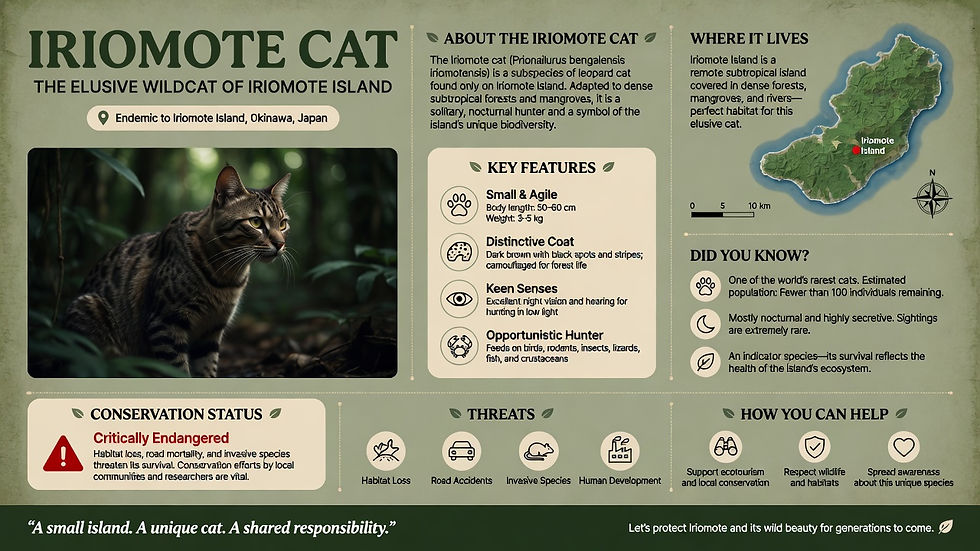
Iriomote cats resemble a sturdy domestic cat in size. Adults typically weigh 3 to 5 kilograms (6.5 to 11 pounds). Head and body length measures about 45 to 60 centimeters (18 to 24 inches). The tail is relatively short and thick, measuring 20 to 25 centimeters (8 to 10 inches).
The coat is dusky to dark brown or grayish. It is covered in long coarse hair marked by rows of dark spots. These spots often fuse into broken bands along the flanks and back. Distinctive features include rounded ears with white spots on the back, white fur around the eyes, a large flat nose, and a relatively fat tail. These traits help the cat blend into the dense island undergrowth.
Habitat and Range
This cat occupies the smallest habitat of any wild cat species. It prefers lowland subtropical evergreen broad-leaved forests, riverine areas, coastal forests, mangrove belts, swamps, forest edges, and agricultural mosaics near water.
Although it ranges across much of the island, core activity centers on gentle slopes and low-elevation zones below 200 meters (660 feet). These are the same coastal lowlands that attract human settlement, roads, and tourism. Iriomote Island, together with nearby areas, received UNESCO World Natural Heritage status. This recognition has increased visitor numbers and development pressure.
Behavior, Diet, and Reproduction

Iriomote cats are largely solitary and territorial. Home ranges typically span 1 to 7 square kilometers (0.4 to 2.7 square miles). Males hold larger areas that may overlap those of one or two females. They are mostly nocturnal or crepuscular, though activity patterns shift with breeding and prey availability. Unlike many cats, they show little fear of water and occasionally swim.
Their diet stands out as one of the most diverse among felids. Researchers have documented more than 95 prey species. They take rodents such as black rats, birds, reptiles, amphibians (especially frogs), insects, crustaceans, bats, and even young wild pigs or freshwater prawns. This broad menu reflects adaptation to a tiny island with limited resources.
Breeding usually peaks from February to May. Females give birth to one to three kittens (commonly two) after a gestation of roughly 60 to 70 days. Births often occur in tree hollows or caves between April and July. Kittens stay with the mother for several months and reach independence later in the year. Sexual maturity can occur as early as 8 to 12 months. Wild lifespan averages 7 to 8 years, though human-related mortality often shortens it.
Conservation Status and Threats

The IUCN Red List has classified the Iriomote cat as Critically Endangered since 2008. The single population contains fewer than 250 mature individuals and shows signs of decline. Japan lists it as Critically Endangered on its national Red List. It is protected as a Special Natural Monument and a National Endangered Species.
Primary threats include habitat loss and fragmentation from agriculture, road construction, and tourism infrastructure. Roadkill remains especially devastating. Dozens of cats have died on the main coastal road over recent decades. Some years have recorded up to nine fatalities, a significant percentage of the total population.
Other pressures involve traps set for wild boar or crabs, predation or competition from dogs and formerly feral cats, potential disease transmission, and the genetic risks of a tiny isolated population. Tourism growth following UNESCO recognition continues to intensify human presence in key lowland habitats.
Human Responsibility and Biblical Stewardship
God specifically charged humanity with care for the planet and its creatures. Genesis 1:26-28 states: “Then God said, ‘Let Us make man in Our image, according to Our likeness; let them have dominion over the fish of the sea, over the birds of the air, and over the cattle, over all the earth and over every creeping thing that creeps on the earth.’
So God created man in His own image; in the image of God He created him; male and female He created them. Then God blessed them, and God said to them, ‘Be fruitful and multiply; fill the earth and subdue it; have dominion over the fish of the sea, over the birds of the air, and over every living thing that moves on the earth.’”
Genesis 2:15 adds: “Then the Lord God took the man and put him in the garden of Eden to tend and keep it.” Dominion means responsible stewardship, not reckless ownership.
Mankind has largely failed this charge through apathy, greed, and vanity. Apathy allows unique species like the Iriomote cat to slip toward extinction while people look away.
Greed drives habitat conversion and short-term economic gain at the expense of long-term ecological health. Vanity elevates personal comfort and appearance above the welfare of other living beings. These patterns mark a collective failure of the stewardship role given at creation. The tone here remains one of sober recognition rather than harsh condemnation. The failure is real, the consequences visible, and the call to better care remains open.
Greenwashing and Institutional Failures
Corporations, politicians, and much of mainstream media frequently engage in greenwashing. They announce ambitious environmental goals, produce glossy reports, and promote carefully worded campaigns. Actual habitat protection, enforcement against habitat destruction, and meaningful reductions in wildlife threats lag far behind the rhetoric.
Public relations often outpaces genuine action. The result is the appearance of care without the substance required to reverse declines in species such as the Iriomote cat.
Fashion, Pharmaceuticals, and the Cost to Wildlife
The fashion industry and some pharmaceutical practices regard animals as mere resources for parts and materials. The demand for animal skins and other products fuels illegal fur markets and provides poachers with ongoing financial motivation. Individuals who wear animal hides for vanity do not appear elegant but rather as contributors to a system that stains the supply chain with blood. The visual effect seldom aligns with their self-perception, conveying indifference instead of sophistication.
Pharmaceuticals use animal parts to produce many compounds of limited or questionable long-term benefit for human health. The broader industry contributes to pressure on wild populations and habitats. Neither sector demonstrates consistent regard for animal welfare, habitat integrity, or the cascading consequences already visible worldwide.
Environmental rhetoric that focuses narrowly on climate change often overlooks or underfunds the direct, ongoing destruction of species and ecosystems. That destruction harms not only wildlife but the ecological systems on which human well-being ultimately depends. Shame attaches to the continued failure to act with seriousness proportional to the losses.
Honoring Animals Through Design and Action

Cattytude chooses a different path. The brand prefers to honor animals with prints that celebrate their magnificence without requiring the death or exploitation of living creatures. Made-to-order production reduces waste compared with bulk ordering and mass manufacturing. Suppliers are selected for genuine commitment to environmental care and animal welfare.
Ten percent of each sale supports organizations dedicated to wild cat and wildlife conservation:
These choices reflect a practical commitment to stewardship rather than empty statements. Supporting such models encourages production systems that leave more room for wild places and the animals that inhabit them.
What Readers Can Do
Learn about the Iriomote cat and share accurate information. Support organizations that fund on-the-ground protection, roadkill mitigation, habitat management, and research on Iriomote Island. Choose products and companies that minimize waste and avoid animal-derived materials obtained through exploitation.
Advocate for genuine habitat safeguards rather than symbolic announcements. Every reduction in demand for destructive practices and every contribution to effective conservation increases the odds that this unique island cat continues to exist.
The Iriomote cat survives today only because its small island still retains enough forest and wetland. Continued human choices will decide whether that residual habitat remains sufficient. Stewardship begins with clear-eyed recognition of past failures and deliberate steps toward better care of the living world entrusted to us.
References
IUCN Red List: Prionailurus bengalensis ssp. iriomotensis: https://www.iucnredlist.org/species/18151/97215980
Iriomote Wildlife Conservation Center: What Is an Iriomote Cat: https://iwcc.jp/english/iriomotecat/cat/
Big Cat Rescue: Iriomote Cat Facts: https://bigcatrescue.org/conservation-news/iriomote-cat-facts
Wikipedia: Iriomote cat: https://en.wikipedia.org/wiki/Iriomote_cat
The Japan Times: The last of Japan’s wildcats: https://www.japantimes.co.jp/environment/2023/10/15/wildlife/endangered-tsushima-iriomote-cats-conservation/
Japan Tiger Elephant Organization: Iriomote Cat: https://www.jtef.jp/en/iriomote-cat/
Frequently Asked Questions
What is the scientific name of the Iriomote cat?
Prionailurus bengalensis iriomotensis. It is treated as a subspecies of the leopard cat, though its extreme isolation has led some earlier classifications to regard it as a full species.
How many Iriomote cats remain?
Estimates center around 100 individuals. The single population is considered declining or, at best, stable at a critically low level.
Where does the Iriomote cat live?
Only on Iriomote Island, Okinawa Prefecture, Japan. It favors lowland forests, mangroves, riversides, and forest edges.
Why is the Iriomote cat critically endangered?
Extremely small population size, restriction to one island, habitat loss from development and roads, high rates of vehicle collisions, and secondary pressures from dogs, traps, and potential disease.
What does the Iriomote cat eat?
An unusually wide range of prey including rodents, birds, frogs, lizards, snakes, insects, crustaceans, bats, and other available small animals.
Is the Iriomote cat protected by law?
Yes. It is a Special Natural Monument and National Endangered Species in Japan, with legal protections and active conservation measures on the island.
How can individuals help?
Support reputable conservation organizations working on wild cats and island habitats. Choose low-waste and non-exploitative products. Reduce demand for items linked to habitat destruction or illegal wildlife trade. Promote accurate public awareness of the species' plight.


Comments