
Bornean Bay Cat: The Rarest Wild Cat You've Never Seen

The Bornean Bay Cat (Catopuma badia) is one of the rarest, most elusive, and least understood wild cats on Earth, and there are fewer than 2500 of them left. Hidden deep within the shrinking rainforests of Borneo, this secretive feline has become almost mythical. Even experienced wildlife researchers can spend years in the jungle without ever seeing one.
While social media influencers chase likes, politicians make empty promises, corporations issue glossy sustainability reports, and consumers often look the other way, the Bornean Bay Cat continues to lose the one thing it cannot survive without: its habitat.
At Cattytude, we believe every wild cat matters, whether it is a tiger that captures headlines or a little-known forest ghost that few people have ever heard of. The Bornean Bay Cat is one of God's magnificent creations, and its struggle serves as a powerful reminder that humanity has a responsibility to be good stewards of the natural world.
Unfortunately, far too many people have chosen apathy over action.
Bornean Bay Cat Quick Facts
Feature | Details |
Scientific Name | Catopuma badia |
Common Names | Bornean Bay Cat, Bay Cat |
Family | Felidae |
Genus | Catopuma |
Range | Borneo only |
Habitat | Tropical rainforests |
Weight | 3 to 4 kg (6.6 to 8.8 lbs) |
Length | 50 to 67 cm (20 to 26 inches) |
Tail Length | 30 to 40 cm (12 to 16 inches) |
Conservation Status | Endangered |
Population | Unknown but believed extremely low |
Activity | Primarily nocturnal and crepuscular |
Diet | Small mammals, birds, reptiles, and insects |
What Is a Bornean Bay Cat?
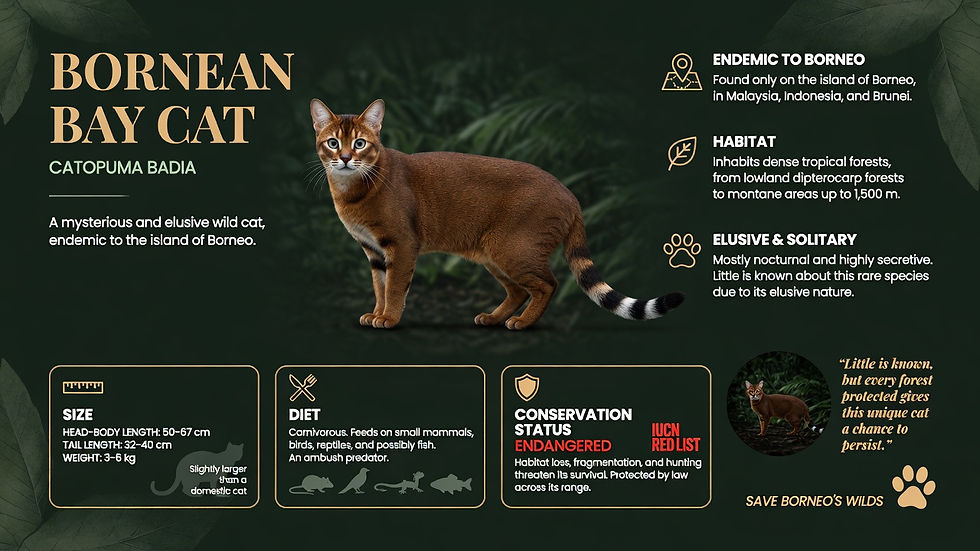
The Bornean bay cat is a small wild cat found nowhere else on Earth except the island of Borneo. It ranks among the most mysterious and least-known members of the cat family.
The first specimen was collected by the naturalist Alfred Russel Wallace in Sarawak in 1855. He sent the poorly preserved skin and skull to the British Museum (arriving in 1856). For nearly two decades, the specimen was misidentified or treated with uncertainty. It was initially logged as a possible flat-headed cat and later thought to be a juvenile Asian golden cat, until John Edward Gray formally described it as a new species, Felis badia, in 1874.
Scientists still know surprisingly little about this feline because confirmed sightings remain extremely rare. For decades, knowledge rested almost entirely on a handful of museum skins, skulls, and occasional reports from local communities. After the last specimen of the early 20th century (1928), the species effectively vanished from scientific records until a live (though dying) female was brought to the Sarawak Museum in 1992.
Modern camera traps have recently provided brief insights into its elusive world. The first photograph of it in the wild was captured in 1998, with more sightings recorded in the following years. However, researchers still have numerous unanswered questions regarding its behavior, ecology, and population status. Currently, none are in captivity or part of species preservation programs. Conservation teams are working on this, but the process is slow due to limited funding and public awareness. Hopefully, significant progress can be achieved before it's too late.
Unlike lions, tigers, or leopards, the Bornean bay cat has largely remained hidden from human attention. Ironically, this obscurity may have heightened its vulnerability: species that stay out of the public spotlight often receive less conservation funding and support.
Appearance
The Bornean Bay Cat is a stunning animal.

Most individuals display a rich chestnut-red coat, although grayish forms have also been documented. Their coloration helps them blend into dense rainforest vegetation.
Distinctive features include:
Rounded ears
Large expressive eyes
A relatively long tail
Pale underparts
Dark markings on the face
A white patch beneath the chin
The tail is particularly notable, featuring a white underside and a dark tip.
Their elegant appearance demonstrates the remarkable diversity God placed within the cat family.
Where Do Bornean Bay Cats Live?
The Bornean Bay Cat is endemic to Borneo, meaning it naturally occurs nowhere else.
Borneo itself is divided among:
Indonesia
Malaysia
Brunei
The species primarily inhabits:
Primary rainforest
Secondary forest
Hill forest
Lowland forest
Remote protected areas
Unfortunately, many of these habitats are disappearing at an alarming rate.
Why Is the Bornean Bay Cat So Rare?
Several factors contribute to its rarity.
1. Naturally Low Population Density
Even in healthy ecosystems, Bornean Bay Cats appear to occur at relatively low numbers.
2. Secretive Behavior
These cats avoid humans and occupy dense forest environments that are difficult to access.
3. Habitat Destruction
This is the biggest threat. As rainforests are cleared for logging, mining operations, roads, and agricultural expansion, the Bay Cat loses territory and prey.
4. Lack of Awareness
Many people have never heard of the species. It is difficult to save what people do not know exists.
The Rainforest Crisis

The greatest threat facing the Bornean Bay Cat is habitat loss. Borneo has experienced some of the highest rates of tropical deforestation in the world. Forests are frequently cleared for:
Palm oil plantations
Timber extraction
Mining operations
Infrastructure development
Agricultural expansion
Corporations often advertise sustainability while continuing activities that fragment wildlife habitat.
Politicians frequently promise environmental protection during speeches and campaigns, only to approve projects that further reduce natural ecosystems.
Many companies engage in greenwashing, presenting themselves as environmentally responsible while benefiting from activities that continue to place wildlife at risk.
The Bornean Bay Cat does not care about public relations campaigns. It needs intact forests. Without forests, there is no future.
Poaching and Wildlife Crime
Although habitat destruction is the primary concern, hunting and wildlife trafficking also threaten the species. Whenever forests become fragmented and roads penetrate deeper into wilderness areas, human access increases.
That often means:
More snares
More illegal hunting
Greater disturbance
Increased wildlife trafficking risks
Poachers frequently justify their actions with excuses involving income or tradition. Neither excuse changes the suffering inflicted upon wildlife.
The fashion industry also deserves scrutiny. For decades, portions of the fashion trade have profited from animal skins, fur, and exotic wildlife products. While regulations have improved in some areas, demand for animal-derived luxury items continues to fuel exploitation.
Cattytude rejects that approach entirely. Instead of using animals, Cattytude celebrates them through artwork, education, conservation awareness, and animal-inspired prints. A leopard pattern belongs on fabric design, not on the skin of a dead animal.
Humanity's Moral Failure
The crisis facing the Bornean Bay Cat is not simply an environmental issue. It is a moral issue.
Biblical scripture repeatedly teaches stewardship of creation. Humanity was entrusted with caring for the Earth, not exploiting it recklessly.
Too often, society embraces the very sins warned against throughout the Bible.
Sloth
Many people know wildlife is disappearing. They simply do nothing. Apathy may be socially acceptable, but it remains destructive. Ignoring suffering because it feels inconvenient is a form of neglect.
Greed
When profit becomes more important than ecosystems, species pay the price. Ancient forests that took centuries to develop can be destroyed in weeks.
Vanity
Some individuals and organizations care more about appearing environmentally responsible than actually being responsible. Photo opportunities, corporate slogans, and public relations campaigns cannot replace meaningful conservation action.
The Bornean Bay Cat cannot survive on hashtags. It survives on habitat.
Why the Bornean Bay Cat Matters
Every species has value because every species reflects the creativity of its Creator.
The Bornean Bay Cat:
Helps maintain ecological balance
Controls prey populations
Contributes to biodiversity
Represents millions of years of evolutionary history
Demonstrates the extraordinary diversity of God's creation
If humanity allows species like this to vanish, something irreplaceable disappears forever.
Cattytude's Commitment to Wild Cat Conservation
Cattytude believes awareness must lead to action. That is why Cattytude helps support organizations working to protect wildlife and educate the public about conservation.
Currently, 10% of every sale helps support:
Cattytude also raises awareness through educational content that highlights both famous and lesser-known wild cats, including species like the Bornean Bay Cat that are too often overlooked.
What Can People Do?
You do not need to be a scientist to help. You can:
Learn about endangered wildlife
Support reputable conservation organizations
Avoid products linked to habitat destruction
Reject wildlife-derived fashion products
Share conservation information
Encourage responsible corporate practices
Vote for leaders who prioritize genuine environmental stewardship
Small actions become powerful when multiplied across communities.
Fascinating Bornean Bay Cat Facts
It is found only on Borneo.
It is among the least-studied cats in the world.
Many wildlife experts have never seen one in person.
Camera traps provide much of what researchers know today.
It is closely related to the Asian Golden Cat.
Scientists continue discovering new information about its behavior and ecology.
Frequently Asked Questions
How many Bornean Bay Cats are left?
No precise population estimate exists. Scientists believe the species is extremely rare and may number only a few thousand individuals, possibly fewer.
Is the Bornean Bay Cat endangered?
Yes. The species is classified as Endangered due to habitat loss, fragmentation, and other human-related threats.
Where does the Bornean Bay Cat live?
Only on the island of Borneo in Southeast Asia.
Can you see one in a zoo?
They are virtually absent from zoological collections and remain extraordinarily difficult to observe.
What does the Bornean Bay Cat eat?
Its diet likely includes small mammals, birds, reptiles, and other small prey.
What is the biggest threat to the species?
Habitat destruction caused by deforestation and land conversion remains the greatest threat.
Why should people care about such a little-known cat?
Every species plays a role in its ecosystem. Losing the Bornean Bay Cat would mean losing a unique part of Earth's biodiversity forever.
Final Thoughts
The Bornean Bay Cat is not famous. It does not attract the attention that tigers, lions, and leopards receive. Yet its survival matters just as much.
Hidden beneath the rainforest canopy of Borneo lives a remarkable creature that has survived for thousands of years. What it may not survive is human indifference. The future of the Bornean Bay Cat depends on whether people choose stewardship over exploitation, responsibility over apathy, and conservation over greed.
If we continue treating wildlife as expendable, more species will disappear. If we choose to care, learn, and act, there is still hope that this elusive forest phantom will remain part of God's magnificent creation for generations to come.


Comments