
White Lions: What Makes Them So Special?

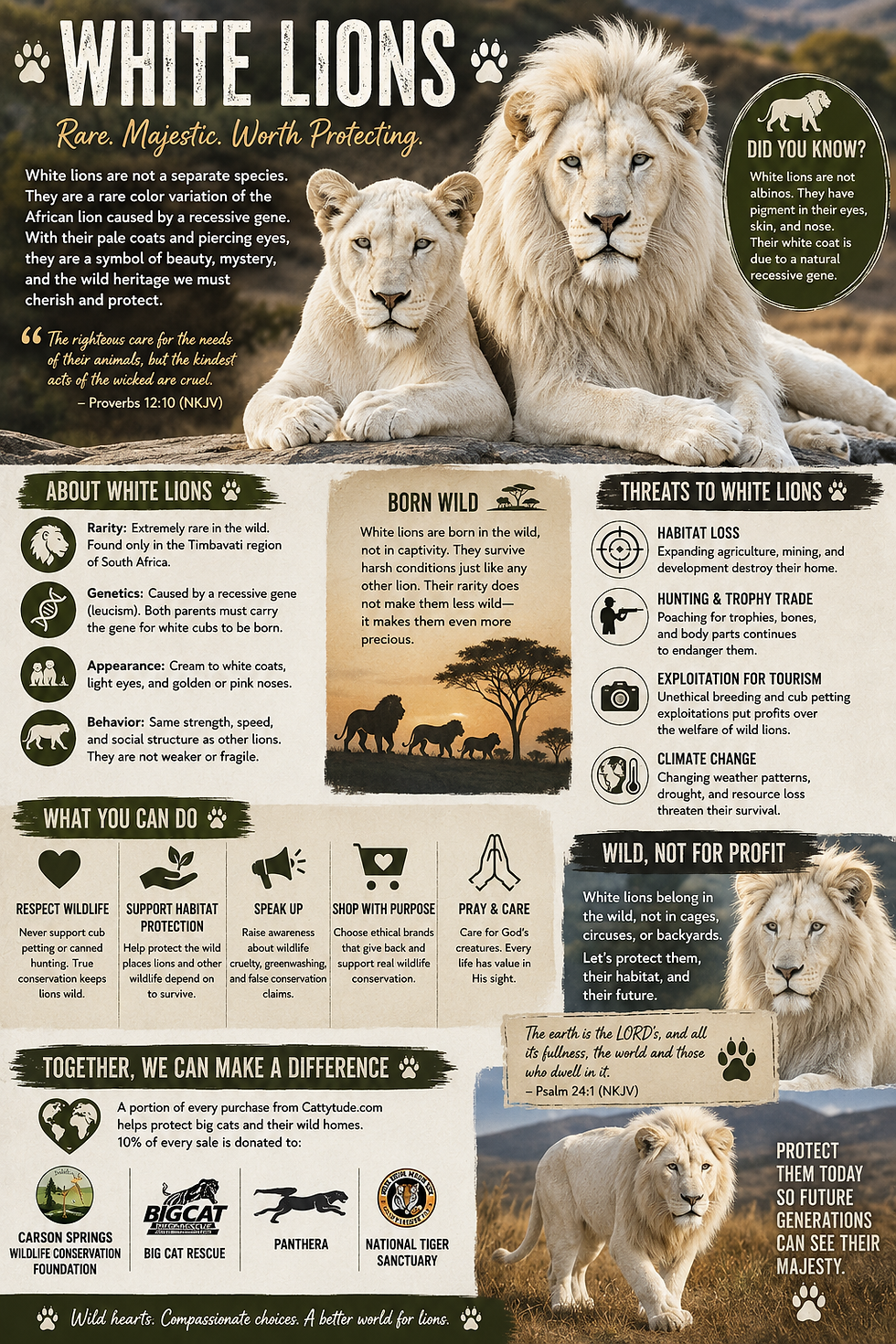
Few animals can stop people in their tracks quite like a white lion. There is something almost surreal about seeing one, especially when that pale coat stands out against the golden grasses of Africa. But white lions are much more than a striking colour variation. Their genetics, natural history, and troubled relationship with human exploitation make them one of the most fascinating stories in the world of big cats.
White lions are African lions with a naturally occurring genetic colour variation. They're not albinos, not a separate species, and not created by humans. Their story begins in the wild, particularly in the Timbavati region of South Africa, where these extraordinary animals have occurred naturally. Sadly, their rarity also made them a target for people who saw an opportunity to turn something remarkable into something profitable.
That is where their story becomes much darker.
A White Lion Is Not an Albino Lion
One of the most common misconceptions about white lions is that their colour means they are albino. It does not. White lions have a recessive genetic variation associated with leucism, which affects pigmentation differently from albinism. They retain pigmentation in their skin and eyes, which is why their eyes are not necessarily the pink or reddish colour commonly associated with albinism.
The genetic trait is recessive, meaning a lion can carry it without displaying the white coat. Two lions carrying the appropriate genetic variation can produce a white cub when that cub inherits the relevant variant from both parents. This is one reason white lions can appear unexpectedly within an otherwise golden population.
That genetic rarity is part of what makes them so fascinating. The white lion is not a different kind of lion. It is one of the many ways nature can express genetic variation within a species.
Why Are Most Lions Golden?
The familiar golden or tawny coat of an African lion is more than a beautiful colour. It also works well within the environments where lions live. Dry grasses, scrub and earthy colours can provide a lion with a degree of camouflage when it is stalking prey or moving through its territory.
A white lion is obviously much easier for the human eye to spot in many of those surroundings. That does not mean the animal is incapable of hunting or surviving in the wild. White lions have successfully hunted and lived in free-ranging conditions, demonstrating that their unusual appearance does not automatically prevent them from functioning as lions.
Lions are also social animals. Living within a pride can provide opportunities for cooperation, protection and shared feeding. A white lion does not suddenly lose its instincts just because its coat is pale.
The colour is unusual, but the lion is not.
The White Lions of Timbavati
The Timbavati region of South Africa is particularly important to the natural history of white lions. Reports of white lions in this area have existed for generations, and scientific research has confirmed that the genetic trait responsible for their unusual colouring occurs naturally within the regional lion population.
This is an important distinction because white lions are sometimes presented as though their existence is entirely the result of captive breeding. It's not. Humans may have manipulated their numbers and breeding in captivity, but the genetic variation itself is natural.
The wild population is where the story really matters.
When a naturally occurring trait exists within a wild population, protecting that population protects far more than individual animals. It protects genetic diversity, ecological relationships, and the natural processes that allowed that variation to exist in the first place.
How Humans Turned Rarity Into Commodity
Unfortunately, humans have never been particularly good at leaving rare things alone.
When it became apparent how rare white lions were, their worth as captive animals rose. They were taken from their natural habitat and introduced into captive breeding programs, tourist sites, and hunting ventures. Even tawny lions thought to possess the recessive gene gained value, as breeders aimed to produce more white cubs.
The result was exactly the opposite of what responsible conservation should accomplish. Instead of protecting the rare genetic variation where it naturally occurred, people began treating it as something they could reproduce and sell.
That's the point where admiration becomes exploitation. A wild white lion is a remarkable expression of biodiversity. A lion deliberately bred because customers will pay more to see a rare colour is a commercial product.
Those are not the same thing.
When Beauty Becomes a Trap
There's a sad irony in the history of white lions. Their beauty helped make them vulnerable.
Many people wanted to see them, while others were eager to breed them. The desire to own these creatures was strong among enthusiasts, and photographers sought to capture their beauty on film. Unfortunately, some individuals wished to harm them.
The more unusual the animal looked, the more attention it received. The more attention it received, the more money could be made from it. The same beauty that should have inspired protection instead became part of the reason humans interfered with the animals.
Fashion plays a significant role in shaping consumer desires. It influences trends and drives people to seek new styles and products. As designers introduce innovative concepts, the market responds with increased demand. This cycle continues, making fashion a powerful force in the economy.
Captive Breeding Is Not Automatically Conservation
This is an important distinction that gets lost far too often. There are legitimate reasons for carefully managed captive breeding. Conservation programs can use breeding to protect genetic diversity, support endangered populations and, under appropriate circumstances, help restore animals to the wild.
But deliberately breeding animals for unusual physical traits because those traits are commercially attractive is not the same thing.
When breeding becomes focused on producing a particular colour, the gene pool can become dangerously narrow. Inbreeding can increase the risk of inherited health problems and physical abnormalities. Animal welfare organizations have repeatedly raised concerns about breeding wild animals for unusual appearance rather than for their health and conservation needs.
A healthy lion is more important than a fashionable lion. Its genetically diverse population is more important than a profitable colour. And a wild population is more important than a collection of animals produced for human entertainment and greed.
The Seven Deadly Sins and Wildlife
The white lion's story is also a painful example of how the seven deadly sins can become woven into modern society.
Greed sees wildlife as an opportunity to make money at its expense.
Pride turns a rare animal into a status symbol.
Envy makes people want what somebody else has.
Gluttony tells us that we must have more than what we have now.
Lust turns beauty into something to possess.
Wrath gives people excuses to destroy and kill.
Sloth allows people to look away because admitting the truth might require making lifestyle changes.
And don't just think poachers are to blame. While they are part of the problem, they're not the core of it. They're encouraged to continue their despicable trade due to greedy consumers, corporations, and industries who have zero regard for anything other than satisfying themselves. They refuse to change course, even upon knowing their methods are not only destructive but, in the end, counterproductive.
What happens when the valuable resources are gone? Habitat loss does more than just displace and kill animals. It disrupts the entire ecosystem that is, in truth, the key contributor to climate change and other environmental disasters.
The luxury fashion trade doesn't help, either. It encourages vanity and excess. Just as offensive as celebrities and the elite who think sporting the carcass of an animal is attractive are the politicians who turn a blind eye instead of truly serving the country they're supposed to represent.
Corporations Need to Be Held Accountable

Corporations have enormous power to influence what people buy and what industries produce. They can also use that power responsibly, or they can use it to squeeze as much profit as possible from the world around them.
Greenwashing has made that problem even more frustrating. A company can cover its marketing in pictures of forests, animals, and green leaves while continuing practices that damage ecosystems. A sustainability slogan does not automatically make a business sustainable.
If a corporation genuinely cares about wildlife, consumers should be able to see that commitment in its actions.
Where are the measurable goals?
Where is the transparency?
Where is the accountability?
Where is the evidence that the company is actually reducing harm?
Wildlife does not benefit from clever advertising. It benefits from protected habitat, responsible practices, and people willing to put conservation ahead of profit.
The Fashion Trade Needs to Leave Wildlife Alone
The fur trade is another example of society refusing to let go of an outdated idea. For generations, animal fur was marketed as the ultimate symbol of luxury. The message was simple: the more exclusive the animal, the more impressive the garment.
But we live in a very different world now. We can create beautiful prints that reproduce the appearance of animal coats. We can make synthetic fur. We can create realistic textures and patterns without killing the animal that inspired them.
We can wear leopard print without wearing a leopard. We can wear tiger stripes without wearing a tiger. We can celebrate the beauty of wildlife without turning wildlife into clothing.
That is not less fashionable. It is more creative. The animal gets to keep its life and its coat, while people still get to enjoy the designs they love.
There is absolutely nothing wrong with loving the appearance of wildlife. There is something wrong with believing we need to own the animal itself.
Pharmaceuticals and the Cost of Human Demand
The pharmaceutical industry deserves scrutiny whenever commercial practices contribute to biodiversity loss or unnecessary exploitation of wildlife.
Medicine and scientific research have enormous value. Nobody should pretend otherwise. But legitimate scientific goals do not mean every method of obtaining natural resources should be accepted without question.
Businesses need to explore alternatives, safeguard ecosystems, and prioritize responsible sourcing. The modern world has remarkable technology. We should use it to reduce our destruction of nature, not to find increasingly efficient ways of exploiting it.
Politicians Need to Do More Than Talk
Wildlife conservation is a political duty as well. Governments make legal decisions and set regulations to guide practices. These authorities control enforcement. Political processes determine funding for protected areas, and they also establish the methods for tackling wildlife crime.
That means politicians have enormous influence over the future of wild animals.
Unfortunately, conservation speeches are easy. Meaningful conservation policy is much harder.
Standing up to industries with money and influence is essential. Enforcing laws, even when inconvenient, is a necessary step. Protecting habitat becomes crucial when development pressures are intense. Furthermore, governments must think beyond the next election.
After years of concern regarding animal welfare and conservation, South Africa has moved to terminate the commercial captive lion breeding industry. These efforts illustrate that political action can be impactful, yet laws are only significant when governments implement them effectively.
Wildlife cannot survive on promises.
The Truth About Poaching
Poaching is one of the most obvious forms of wildlife exploitation, but it is only part of the problem. A poacher kills because there is a market. Someone wants the product and is willing to pay money for it. As long as there's always a buyer, the poachers have a reason to continue their despicable trade.
It's easy to blame the individual holding the weapon while overlooking the buyer who provided the incentive. Similarly, it's convenient to denounce illegal wildlife trafficking while still endorsing legal industries that perpetuate the notion that wild animals are meant for human use.
The problem is bigger than one poacher in one field. It is the demand.
Society Has Normalized Too Much
We should not pretend that wildlife exploitation is only the fault of corporations, politicians, and criminals. Society has helped normalize it. We have become accustomed to buying more than we need. We have been taught that luxury means rarity, that status means possession, and that convenience matters more than consequences.
Scrolling past photographs of suffering wildlife often leads to a disconnect, as many still choose to spend money on products that contribute to the same problem. Expressions of love for animals can clash with support for industries that exploit them for profit. While lamenting the plight of endangered species, individuals may inadvertently encourage the fur trade simply because they appreciate its aesthetic appeal.
That contradiction needs to end. We have alternatives, and we have information. We also have choices. Now, are we willing to use them?
White Lions Deserve to Live as Lions
Providing care for a rescued lion that cannot return to the wild is entirely appropriate. Sanctuaries play a vital role for animals genuinely needing lifelong care. However, the presence of sanctuaries should never justify creating more animals in need of rescue.
A white lion shouldn't be bred for entertainment purposes. It shouldn't be showcased simply because they are rare, nor should it be hunted and turned into a trophy. It needs the same things every wild lion needs: habitat, prey, social relationships, space, and freedom. The best place for a wild animal is where it can actually be a wild animal.
White Does Not Mean Better
While it might be tempting to consider white lions more special than golden lions due to their rarity, that's not the main takeaway here. Golden lions are remarkable creatures, with their distinctive coats ideally adapted to the environments where they developed. Their social behavior, hunting skills, and ecological significance are just as captivating as the uncommon color variation seen in white lions.
The white lion is special because its genetic variation is unusual, but this doesn't make the golden lion any less magnificent. They're among the beautiful creations belonging to God's animal kingdom.
What White Lions Can Teach Us About Stewardship
There is a reason stewardship matters so much to Cattytude's approach to wildlife.
For Christians, Scripture makes it clear that humanity has responsibilities toward creation.
Psalm 24:1 says, "The earth is the LORD'S, and the fulness thereof."
Proverbs 12:10 says, "A righteous man regardeth the life of his beast."
That should make us think differently about ownership. Just because we can capture something does not mean we have the right to exploit it to satisfy greed and vanity. We also don't have the right to possess it.
Stewardship means recognizing that our power over the natural world comes with responsibility.
Every Cattytude Purchase Supports Wildlife

Cattytude believes that loving animals should mean doing something for them, not simply putting their faces on merchandise. That's why every purchase on Cattytude supports wildlife conservation. 10% of the purchase price from every sale is dedicated to the four wildlife organizations Cattytude supports:
Each organization contributes to wildlife protection in its own way, from animal rescue and sanctuary care to education and conservation efforts focused on wild species and their habitats.
So when someone buys from Cattytude, the purchase is about more than getting another cat-themed product. It's a way to turn a love of animals into support for animals.
That matters. Our spending choices have consequences. Every purchase helps determine which businesses grow, which products are made, and which values receive financial support.
If we are going to spend money anyway, why not let some of that money help wildlife?
Wear the Print, Not the Animal

We can easily be fashionable without exploiting any animal. Animal prints give us the appearance we love without requiring the animal itself.
That should be the future of wildlife-inspired fashion. Want leopard spots? Wear the print. Love tiger stripes? Wear the stripes. Want a design inspired by a lion? Wear it proudly.
There's no need to turn a living creature into a piece of clothing to prove that you admire it. In fact, leaving the animal alive may be the strongest possible statement that you truly do.
The White Lion's Story Is Bigger Than Its Color
The white lion captures our attention because of its coat. It keeps our attention because of its story.
Here is an animal created by a natural genetic variation that humans found fascinating. Instead of simply protecting that variation, people saw opportunities to breed, sell, display, and exploit it.
That pattern should sound familiar. Humans have done the same thing to countless species once we find something beautiful and decide we want it. We turn it into a product, and we consume it. Then, we have the gall to wonder why they're disappearing.
It's time to break that cycle. The answer is not to stop admiring wildlife. The answer is to learn how to admire wildlife without destroying it.
A White Lion Is Worth More Alive
White lions are special because they show us how remarkable nature can be. Yes, their genetics are unusual, and their history is tied to a unique part of Africa.
They're special because their story exposes the consequences of human greed. But they are not special because they can be sold.
They're not special because they can be bred for profit or have their heads hang like trophies from a wall.
Most importantly, they're special because they're alive. That should be enough. This applies to every animal. We shouldn't wait for an endangered species list before deciding that an animal deserves protection.
And we certainly should not need to wear an animal's skin before admitting that we love its appearance. Let the lions (regardless of color) keep their coats. Let wildlife remain wildlife. That is what conservation should have meant all along.
Frequently Asked Questions
What causes the white coat?
A rare recessive genetic variation associated with leucism causes the unusually pale coat.
Is a white lion an albino?
No. White lions retain pigmentation and are genetically different from albino animals.
Can white lions hunt?
Yes. Wild and reintroduced individuals have demonstrated that they can hunt and feed themselves.
Are white lions found naturally?
Yes. Their natural occurrence is strongly associated with the Timbavati and surrounding southern African region.
Can golden-colored parents produce a white cub?
Yes. Parents that carry the recessive genetic variation can produce a white offspring if the cub inherits the appropriate variant from both.
Does being white make a lion unhealthy?
The colour itself does not automatically make an individual unhealthy. The greater concern arises when people deliberately breed animals within restricted genetic pools to produce the colour.
Why can captive breeding become dangerous?
Breeding for appearance can encourage inbreeding and reduce genetic diversity, potentially increasing inherited health problems.
Are white lions endangered because they are white?
Their conservation concerns are tied to the broader threats facing African lions, along with the history of removing animals carrying the rare genetic variation from wild populations.
Why should people stop buying fur?
Modern fashion offers alternatives that can reproduce animal patterns and textures without requiring an animal to be killed for its coat.
What is the biggest threat to wildlife?
There is no single threat affecting every species. Habitat loss, illegal killing, wildlife trafficking, climate pressures, pollution, unsustainable exploitation, and human-wildlife conflict can all play major roles.
How can consumers help?
Choose products responsibly, avoid wildlife-derived luxury goods, support credible conservation organizations, and pay attention to how businesses treat animals and the environment.
What organizations does Cattytude support?
Cattytude supports Carson Springs Wildlife Conservation Foundation, Big Cat Rescue, Panthera, and National Tiger Sanctuary.
How does every purchase help?
10% of the purchase price from every Cattytude sale is dedicated to the four supported wildlife organizations.
References and Further Reading
White Lion Genetics and Natural History
Health, Genetics and Captive Breeding
Wildlife Exploitation and Conservation


Comments