

Serval Cats: Africa’s Long-Legged Hunters Under Growing Threat
- Millie Zeiler
- Aug 8
- 4 min read

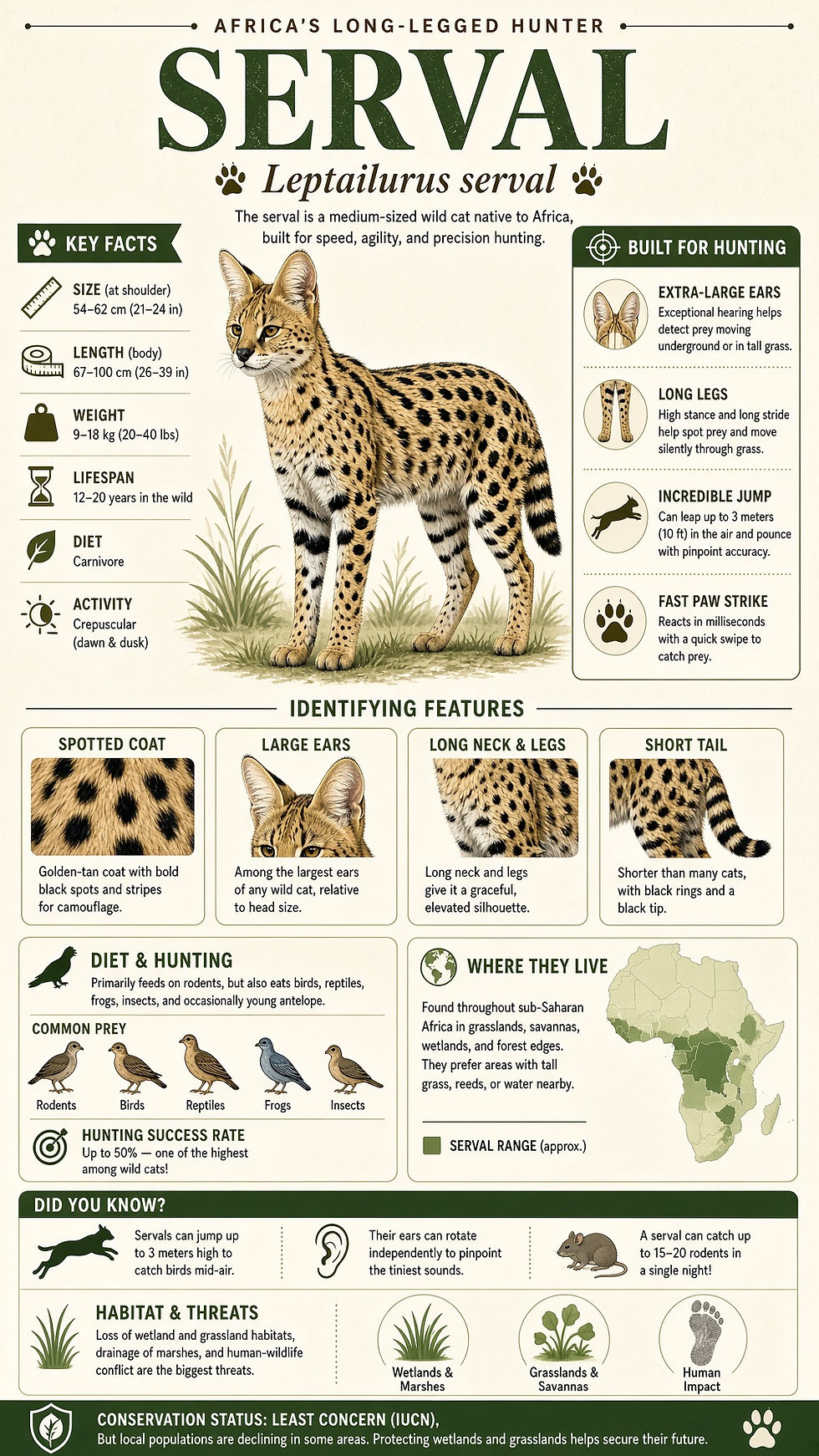
God designed the serval with purpose. Long legs for explosive jumps. Oversized ears that pick up the faintest rustle of prey underground. A lean, spotted body built for the tall grass and wetlands of Africa. These cats can launch more than nine feet straight up and snatch birds right out of the air. They are master rodent hunters. They thrive where water and cover meet.
That same design is under pressure right now.
Meet the Serval Cat
The serval (Leptailurus serval) is a medium-sized wild cat native to sub-Saharan Africa. Adults typically weigh between 19 and 40 pounds. Their legs are unusually long relative to body size, giving them a distinctive high-stepping look. Big ears help them locate prey by sound alone. They prefer well-watered grasslands, reed beds, and wetlands where rodents, birds, frogs, and insects are plentiful.
Servals are mostly solitary and active at dawn and dusk. Females raise litters of one to three kittens after a gestation of about 70 to 75 days. In the wild, they can live around 10 to 12 years. In protected settings, they often live longer.
Conservation Status and Real Threats
The IUCN lists the serval as Least Concern overall, with a relatively stable population across much of its range. That global label hides harder truths. Some regional populations, especially in North Africa, are in serious trouble and have been assessed as Critically Endangered or near extinction. Habitat loss is the primary long-term threat.
Wetlands get drained for agriculture and development. Grasslands get overgrazed or burned. Roads slice through remaining territory and kill animals.
Additional pressure comes from the illegal trade in skins and body parts, the exotic pet market, and conflict with people when servals take poultry.
Fashion, Medicine, and Poachers
Cattytude rejects the idea that wild animals exist to supply fashion and traditional medicine markets. Serval pelts still appear in trade, sometimes passed off as cheaper substitutes for leopard or cheetah skins. Parts are used in ceremonial attire and traditional medicine in parts of Africa. That demand is exactly why poachers keep operating. As long as buyers exist, the traps stay set, and the pressure continues.
The exotic pet trade adds another layer. Wild-caught or captive animals get pulled into private ownership that rarely meets their complex needs. None of this honors the design God placed in these animals.
The Greenwashing Scam

Politicians issue statements. Corporations roll out glossy sustainability campaigns. Mainstream media runs stories that celebrate symbolic gestures while the wetlands keep disappearing. Much of it is greenwashing. Talk without matching results. Photo ops without meaningful protection of habitat or enforcement against trade. The animals on the ground feel none of the PR. They feel the loss of cover and prey.
Humanity’s Broken Charge and the Seven Deadly Sins
God charged people to look after the earth and the creatures that fill it. We have failed that charge, especially in the last hundred years. What we call progress has often meant rapid conversion of living landscapes into something that cannot sustain the species that once thrived there. We are undermining the systems that support life, including our own.
The seven deadly sins show up clearly in this failure:
Pride treats human plans as superior to the order of creation and rearranges ecosystems without regard for the species that depend on them.
Greed drives the conversion of wetlands into short-term profit and the sale of skins and parts.
Lust for novelty and status fuels demand for exotic pets and wild-cat products.
Envy of rarer or more prestigious animals leads some to treat serval pelts as stand-ins.
Gluttony of land and resources consumes habitat faster than it can recover.
Wrath appears when people kill servals in retaliation for taking a few chickens instead of seeking better solutions.
Sloth, especially in the form of apathy, may be the most damaging. Apathy is the lukewarm spirit Scripture warns against. It is the same condition that leads to being spewed out. Knowing the harm and choosing not to act keeps the decline going.
How Cattytude Fights Back

Every purchase at Cattytude is a mission. 10% of every sale goes to the organizations working to protect wild cats and their habitats. They are:
These groups are among many who provide lifelong care for rescued animals, fight the trade, protect habitat, and educate people. Cattytude chooses made-to-order production and feline-themed prints to honor God’s creation and reject the waste of mass production. Wear the values. Support the work.
FAQs
Are servals endangered?
Globally, they are listed as Least Concern, but some regional populations face severe pressure and higher risk categories.
What is the biggest threat to servals?
Loss and degradation of wetlands and tall grasslands that provide cover and prey.
Why are servals still hunted or traded?
Demand for skins in fashion and ceremonial use, traditional medicine, and the exotic pet trade keeps the illegal market alive.
Does buying from Cattytude help wild cats?
Yes. Ten percent of every sale supports the three organizations listed above.
Should people keep servals as pets?
No. Servals are wild animals with specialized needs that private ownership rarely meets.
References for Additional Reading
IFAW Serval Cats Facts, Threats & Conservation: https://www.ifaw.org/animals/serval-cats
IUCN Red List. Leptailurus serval. https://www.iucnredlist.org/species/11638/156536762
National Geographic. Serval: https://www.nationalgeographic.com/animals/mammals/facts/serval
IUCN Cat Specialist Serval Group: https://www.catsg.org/living-species-serval

Comments