

The Fascinating World of Wild Cats: From Big to Small
- Millie Zeiler
- May 24
- 4 min read

Updated: Jun 12

Cats, both wild and domestic, have captivated humans for thousands of years. Whether it’s the majestic lion ruling the savanna or a tiny rusty-spotted cat slipping through the undergrowth, the Felidae family showcases an incredible range of adaptations, personalities, and survival strategies. While we often focus on lions, tigers, and our beloved domestic pets, there are actually around 37 to 41 recognized species of wild cats living across nearly every continent except Antarctica. This wild cats guide will cover the different breeds and what makes them so special.
The True Big Cats (Genus Panthera)

The term “big cat” is most accurately applied to the five species in the Panthera genus. These are the only cats capable of roaring due to a special structure in their larynx.
Tiger (Panthera tigris): The largest cat species alive today. Siberian tigers can weigh over 600 pounds. They are powerful swimmers and solitary ambush predators.
Lion (Panthera leo): The only truly social big cat, living in prides. Known as the “king of the jungle,” though they actually prefer open savannas.
Jaguar (Panthera onca): The apex predator of the Americas, with the strongest bite force relative to size of any big cat. Their rosettes have small dots inside — a key identification mark.
Leopard (Panthera pardus): Masters of camouflage and climbing. Extremely adaptable, found from African savannas to Russian forests.
Snow Leopard (Panthera uncia): The “ghost of the mountains.” They live at high altitudes in Central Asia and have incredibly thick fur and long tails for balance.
Near-Big Cats: Cheetah and Cougar

While not classified as big cats, these species are fascinating in their own right.
Cheetah (Acinonyx jubatus): Built for speed rather than power. They can reach 70 mph in short bursts but cannot roar. Their black “tear marks” help reduce sun glare.
Cougar / Puma / Mountain Lion (Puma concolor): One of the most widespread mammals in the Western Hemisphere. Despite their size, they are more closely related to small cats and cannot roar.
Medium-Sized Wild Cats
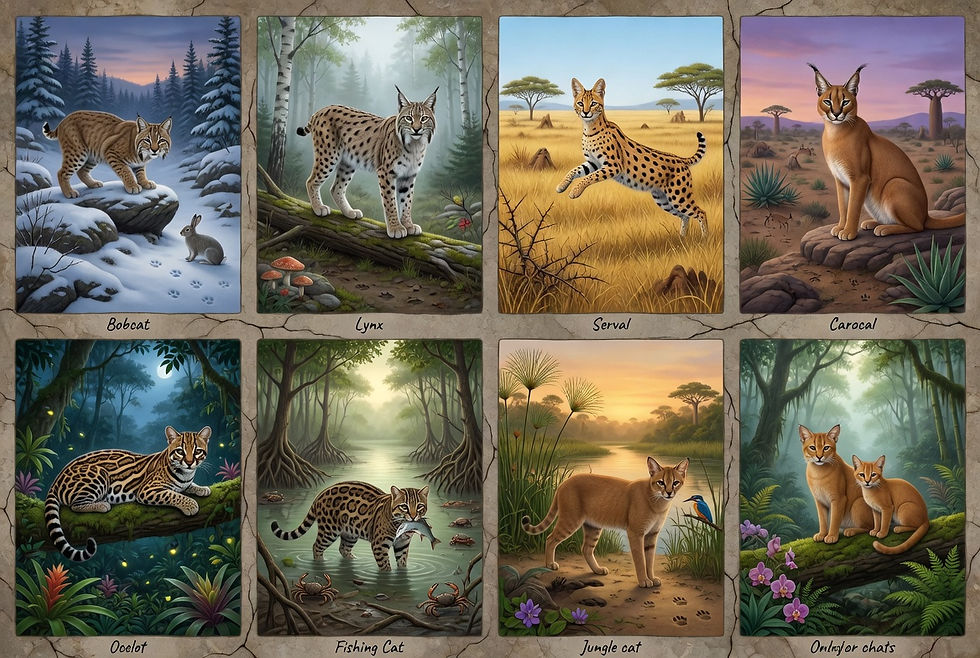
This diverse group includes many fascinating species that often get overlooked:
Bobcat (Lynx rufus): A compact, feisty North American cat with a signature short “bobbed” tail.
Lynx species (Canada, Eurasian, Iberian): Known for long ear tufts and snowshoe-like feet.
Serval (Leptailurus serval): A long-legged, large-eared African hunter with incredible jumping ability.
Caracal (Caracal caracal): Famous for its spectacular ear-tufted leaps to catch birds mid-air.
Ocelot (Leopardus pardalis): A beautifully spotted “mini-leopard” of the Americas.
Fishing Cat (Prionailurus viverrinus): One of the few cats that loves water, with partially webbed toes.
Jungle Cat (Felis chaus): A tall-eared, long-legged reed dweller that hunts during the day.
Golden Cats (Asiatic and African): Striking, solid golden-red coats.
Small Wild Cats

Small Wild Cats: Many of the smallest wild cats are incredibly rare and highly specialized. In total, there are approximately 33 of them. These include:
Rusty-spotted Cat: One of the smallest wild cats in the world.
Black-footed Cat: The deadliest small cat by hunting success rate.
Pampas Cat: Adaptable grassland and scrub specialist from South America.
Andean Mountain Cat: One of the rarest cats in the world, restricted to the high Andes mountains.
Margay: Exceptional tree-climber with remarkable arboreal abilities.
The Domestic Cat (Felis catus)

All domestic cats descend from the African Wildcat (Felis lybica). Through selective breeding and natural adaptation, we now have over 70 recognized breeds, ranging from the massive Maine Coon to the hairless Sphynx.
What Makes Each Species Special?
Every cat species has evolved unique traits for its environment:
Swimming specialists like the Fishing Cat and Tiger.
High-speed sprinters like the Cheetah.
Extreme climbers like the Margay and Leopard.
High-altitude survivors like the Snow Leopard.
Wetland experts like the Jungle Cat and Fishing Cat.
Many medium and small cats have developed remarkable camouflage, specialized hunting techniques, and incredible senses to survive in competitive ecosystems.
Conservation Reality

Sadly, many wildcat species face serious threats. Habitat loss, poaching, and human-wildlife conflict have pushed several species — including the Iberian Lynx, Amur Leopard, and South China Tiger — to the brink of extinction. Conservation efforts focusing on habitat protection and anti-poaching have seen some success stories, particularly with snow leopard and Iberian lynx populations.
Wild cats continue to remind us of nature’s perfect engineering. From the thunderous roar of a lion to the silent stalk of a jungle cat through tall reeds, each species plays a vital role in its ecosystem. Whether you’re drawn to the power of big cats or the quiet mystery of smaller felids, there’s something profoundly special about every member of the cat family.
Embracing Our Love for Cats
As cat enthusiasts, we share a unique bond with these incredible creatures. Our passion for cats can be expressed in many ways, from adopting pets to supporting conservation efforts. We can also showcase our love through cat-themed apparel, accessories, and home goods. After all, our feline friends deserve to be celebrated in style!
So, let’s continue to explore the fascinating world of cats together. Whether you're a fan of the big cats or the small wild ones, there's always something new to learn and appreciate. And remember, every cat has its own story, waiting to be discovered.


Comments