
National Tiger Sanctuary: Giving Rescued Tigers and Other Wildlife a Fighting Chance

Updated: Aug 13

National Tiger Sanctuary Is About More Than Saving Tigers
Some organizations make it easy to remember why compassion matters. National Tiger Sanctuary is one of them.
Located in Saddlebrooke, Missouri, just north of Branson, National Tiger Sanctuary is a nonprofit rescue organization providing permanent homes and lifelong care for rescued exotic and domestic animals. Its work centers heavily on big cats, including tigers and lions, while also incorporating education, conservation awareness, and responsible animal care.
For Cattytude, that mission hits particularly close to home.
Cattytude loves cats. We love their beauty, their individuality, their strength, their mystery and the sheer fact that there is something wonderfully humbling about sharing a planet with these extraordinary animals.
But loving cats should mean more than wearing a cute cat shirt. It should mean standing up for them. It should mean learning about the threats they face. It should mean refusing to support industries that turn animals into commodities. And it should mean putting some of our money where our hearts are.
That is why Cattytude donates 10% of each sale to groups it supports, including National Tiger Sanctuary.
When someone shops for feline-themed apparel, gifts, and other goodies at Cattytude, that purchase can become part of something bigger than a wardrobe or a gift bag. It becomes another small way of saying that animals matter.
Or, as Cattytude likes to say: #MeowAndAmen
Five Tigers Helped Start a Mission
The story of National Tiger Sanctuary traces back to five tiger siblings: Max, Vincent, Paul, Dee and TJ.
Founders Judy McGee and Keith Kinkade raised the five tigers from cubs. Caring for those animals gave them firsthand experience with both the remarkable nature of tigers and the difficult realities surrounding captive wildlife. Those experiences helped inspire the creation of a sanctuary focused on animal welfare, conservation, and education.
An organizational profile identifies National Tiger Sanctuary as having been established in 2000, with the facility developed through private donations and membership support.
What began with five tigers developed into a much broader commitment.
Today, National Tiger Sanctuary provides permanent sanctuary for rescued animals and works to educate visitors about wildlife, conservation and responsible animal care.
That history is important because it illustrates something that is sometimes forgotten when people see a magnificent tiger behind a sanctuary fence.
The animal has a history.
There is a reason it is there.
And there is a very good chance that somebody had to step forward when circumstances left that animal with nowhere else to go.
A Sanctuary Is Not a Substitute for the Wild
This distinction matters enormously. A responsible sanctuary is not claiming that a cage or enclosure is somehow better than a healthy tiger habitat in the wild.
It isn't.
The ideal home for a wild tiger is a functioning wild ecosystem with adequate habitat, prey, water, territory, connectivity and protection from human exploitation. But not every rescued animal can return to the wild.
National Tiger Sanctuary explicitly explains that its purpose is to provide rescued animals that cannot safely return to the wild with the best quality of life possible for the rest of their lives.
That is a completely different philosophy from treating wildlife as disposable entertainment.
The sanctuary's guiding principles include lifelong care, safe and enriching habitats, individual animal welfare, education, dignity, and responsible wildlife stewardship.
That is what the word sanctuary should mean. A forever home. Not a temporary attraction. Not a place where an animal's value disappears when it becomes too old, too large or too expensive.
Meet the Residents Who Call It Home
National Tiger Sanctuary is now home to a diverse collection of rescued animals. Its current residents include tigers such as Siberian tigers Amal and Rani, Truman and Lily, Bengal tiger Kora, and several white tigers including Bashir, Carma and Dakar. The sanctuary also cares for other species beyond its tiger residents.
Every animal has an individual personality and history.
Take Carma, for example. Carma is a white tiger rescued in 2017 as part of a large-scale effort to provide white tigers with safe, lifelong homes. She is known for her distinctive chuff, a friendly vocalization that she uses when greeting familiar caregivers. She enjoys exploring, napping, spending time around her plants, and playing in her pool.
That kind of information is important. A tiger is not simply "a tiger." A tiger is an individual animal. Carma has preferences. She has relationships. She has a personality.
She has a history. And she deserves to have the remainder of her life treated as something valuable.
The Hard Truth: Rescue Is Expensive
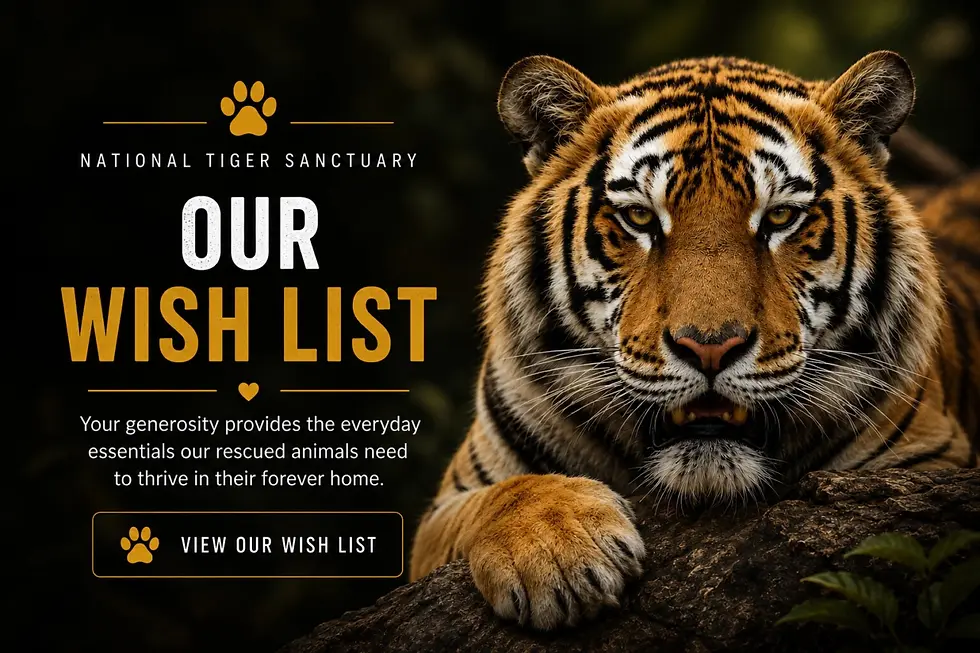
Feel-good stories about rescued animals are wonderful. But rescue itself is not free.
A tiger cannot live on good intentions. A large carnivore requires appropriate food, veterinary care, a safe, secure habitat, enrichment, trained caregivers, ongoing maintenance, and emergency care if something goes wrong.
National Tiger Sanctuary specifically identifies food, veterinary care, enrichment, and lifelong sanctuary as areas supported by donations. It is also a registered 501(c)(3) nonprofit organization and offers both one-time and recurring ways for supporters to contribute.
That means the financial responsibility does not disappear after an animal is rescued. It gets bigger. A sanctuary is making a promise to an animal.
You are safe here.
That promise can potentially last for decades. And somebody has to pay for it. This is one reason donations, memberships, tours, sponsorships, volunteering and responsible shopping partnerships matter.
The public sees the tiger. The sanctuary has to think about the next veterinary examination. The next meal. The next enclosure repair. The next enrichment activity.
The next medical emergency. The next year. And the year after that.
Why Sanctuaries Matter So Much
Imagine a world without responsible sanctuaries. Where does the rescued tiger go? What happens to an animal that cannot safely return to the wild? What happens when a private owner can no longer care for a 400-pound carnivore? What happens when an exotic animal attraction closes? What happens when an animal has been exploited for entertainment and is no longer profitable?
These are not hypothetical questions.
Across the world, wild animals are caught in systems involving illegal trafficking, habitat destruction, exploitation, irresponsible ownership, and commercial demand.
Sanctuaries cannot solve all of those problems.
But they can provide something essential:
A place where an animal's life has value even after its usefulness to humans has ended.
That is powerful. And it is desperately needed.
The Bigger Problem Is Much Bigger Than One Sanctuary
National Tiger Sanctuary can rescue an animal. It cannot, by itself, stop poaching. It cannot protect every forest. It cannot dismantle every trafficking network. It cannot eliminate the international demand for tiger bones, skins, teeth and other wildlife products. It cannot eliminate habitat destruction.
That requires governments, law enforcement agencies, conservation scientists, local communities, responsible businesses and ordinary consumers to work together. Organizations such as Panthera point directly to poaching, illegal wildlife trade, habitat loss and fragmentation, prey depletion and human-wildlife conflict as major threats facing wild cats.
Panthera notes that the illegal wildlife trade is a multibillion-dollar black market involving wild cat furs, teeth, bones and other body parts, as well as live animals. Demand can come from several sectors, including traditional medicine, fashion, decoration, status and the exotic pet trade. That is where the conversation gets uncomfortable. Because money talks.
The Fashion Trade Has a Responsibility
The fashion trade has tremendous cultural and economic influence. It can also help normalize the idea that an animal's body is a luxury material.
Fur
Skins
Teeth
Claws
Exotic animal products
When wildlife becomes a fashion statement, somebody may pay the price long before the finished product reaches a store. That does not mean every person working in fashion participates in wildlife exploitation. It means consumers have enormous power to decide which kinds of products deserve their money. And that power should be used.
Why wear the body of a wild animal when you can celebrate the animal itself? Why buy an actual leopard skin when you can wear a leopard print? Why display a tiger's teeth when you can proudly wear a tiger design? Why turn wildlife into a dead trophy when you can turn your admiration for wildlife into support for conservation?
That is one of the ideas behind Cattytude. Celebrate the animal. Don't wear the animal.
Poaching Exists Because Somebody Is Paying
This is perhaps the ugliest part of the equation. Poachers generally do not kill endangered wildlife simply because they hate animals. There is money behind the killing.
The illegal wildlife trade creates financial incentives for people to capture and kill animals and for trafficking networks to move wildlife products across borders. Panthera describes the illegal wild cat trade as a global, multibillion-dollar market and documents demand for everything from skins and bones to teeth and live animals.
That means conservation cannot simply be about telling people to care. We need to change the economics. If there is money to be made selling wildlife parts, there will be people willing to exploit wildlife.
So we have to create stronger financial incentives for conservation. We have to support organizations that protect animals. We have to support sanctuaries that rescue animals. We have to support conservationists who protect wild populations. We have to support communities that benefit from keeping wildlife alive. And we have to stop rewarding businesses that turn endangered animals into commodities.
Money talks. So let's make our money talk for the animals.
The Exotic Pet and Wildlife Entertainment Problem
An additional unsettling truth is the desire for exotic animals as possessions or attractions. Tigers, for instance, are not domestic cats; they are wild creatures that do not belong in our homes or backyards. These majestic animals should never be used as props or for photo opportunities. Rather than being fashion accessories, they deserve respect and a natural habitat where they can thrive.
National Tiger Sanctuary's educational mission is particularly important here because responsible wildlife education can help people understand that these animals have complex physical and behavioral needs. The sanctuary emphasizes learning, respect, responsible care, and conservation awareness.
That message needs to reach far beyond Missouri. It needs to reach social media. It needs to reach schools. It needs to reach tourists. It needs to reach consumers. And it needs to reach anyone tempted to believe that owning an exotic animal is glamorous.
We Need Sanctuaries. But We Also Need Prevention.
This is the part where simply patting ourselves on the back is not enough. Rescuing an animal after exploitation has already happened is enormously important. But prevention is better.
We need to protect wild habitat before it disappears. We need stronger enforcement against wildlife trafficking. We need to reduce demand for animal body parts. We need to challenge businesses that profit from exploitation. We need responsible tourism.
We need conservation education. We need consumers to ask where their money goes. And we need governments to treat wildlife crime as the serious international crime that it is.
Sanctuaries are part of the solution. They are not the entire solution. National Tiger Sanctuary itself emphasizes conservation awareness and education because protecting wildlife requires changing how people understand and interact with the natural world.
Cattytude's Answer: #MeowAndAmen

This is why Cattytude is proud to support National Tiger Sanctuary. 10% of every Cattytude sale is donated to:
That is not because buying a cat-themed shirt will magically save every tiger on Earth.
It won't. But collective action matters. A single purchase is small. Thousands of purchases are not.
When consumers deliberately choose businesses that support wildlife conservation, they help create a market where compassion has economic value.
Cattytude wants feline lovers to have another option. Instead of wearing the actual body parts of wild animals, celebrate them. Instead of treating wildlife as a commodity, admire it. Instead of contributing to demand for animal products, support organizations working to protect animals. Instead of saying nothing, wear something that starts a conversation.
Wear the print. Save the cat.
Cattytude's Other Conservation Partners
National Tiger Sanctuary is highlighted in Cattytude's conservation spotlight due to its significant role in offering lifelong sanctuary to rescued animals. However, it is not the only one.
Cattytude also supports three other organizations working in different parts of the wildlife conservation puzzle.
Located in Florida, Carson Springs Wildlife Conservation Foundation provides homes for rare and endangered species and combines animal care with conservation education. The organization says its animals include rescued and relocated big cats, and that its work is funded through private support.
Big Cat Rescue has been an important voice in the fight against big cat exploitation and the abuse of captive wild cats.
Panthera works internationally to protect the world's wild cats and their habitats, with programs addressing poaching, illegal wildlife trade, habitat loss and human-wildlife conflict.
Together, these organizations represent different but complementary pieces of the conservation puzzle.
Rescue. Education. Sanctuary. Science. Habitat protection. Anti-poaching work. Public awareness.
We need all of them.
What You Can Do to Help Tigers and Other Big Cats
You do not have to become a wildlife biologist to make a difference.
You can:
Support legitimate wildlife sanctuaries.
Donate when you can.
Volunteer your time.
Learn about the animals you love.
Share credible conservation information.
Avoid wildlife products made from animal skins, bones, teeth, claws, or other body parts.
Be cautious about wildlife tourism that prioritizes entertainment over animal welfare.
Support organizations fighting poaching and wildlife trafficking.
Encourage children to appreciate wild animals without treating them as pets.
Choose businesses that put money toward conservation.
Speak up when wildlife exploitation is presented as luxury, entertainment, or status.
Buy animal-inspired products rather than products made from actual animals.
And yes, you can shop. But shop intelligently. When your purchase supports a conservation organization rather than contributes to the exploitation of wildlife, that is a much better kind of consumer choice.
National Tiger Sanctuary Gives Us Something Worth Celebrating
There is a temptation when discussing endangered wildlife to focus only on the bad news.
Habitat loss is accelerating, and poaching and trafficking still fuel a brutal trade in wildlife. Exploitation thrives on greed, and animals pay the price. Those facts are hard, but they are real.
Yet compassion is real, too. Across the world, supporters step up with time, money, skills, and heart. Rescuers intervene. Educators speak up. Sanctuaries are built. Lifelong commitments are made for animals that can never give anything back.
National Tiger Sanctuary grew from a moment like that. Five tiger siblings helped inspire Judy McGee and Keith Kinkade to devote their lives to animal welfare, conservation, and education. What began as a spark became a lasting mission: permanent homes for rescued animals and a community that chooses compassion over convenience.
Action matters, but it cannot end with awareness. That's not nearly enough.
Everyday choices shape what survives. Spend with intention. Support ethical conservation work. Push back on industries that profit from wildlife exploitation. Stand behind the people doing the difficult, unglamorous work of rescue and protection.
A tiger is worth infinitely more alive than anything taken from its body.
National Tiger Sanctuary is doing its part. Cattytude is doing its part. Now it is time for all of us to do ours.
Love cats? Then love them enough to protect them.
Support the people giving them a second chance.
Support the people protecting their wild cousins.
And when you can choose between wearing an animal and celebrating an animal, choose the animal.
Frequently Asked Questions About National Tiger Sanctuary
Where is National Tiger Sanctuary located?
National Tiger Sanctuary is located at 518 State Highway BB in Saddlebrooke, Missouri, just north of Branson. The sanctuary is open year-round from Wednesday through Sunday, according to its current visitor information.
What is National Tiger Sanctuary?
National Tiger Sanctuary is a nonprofit rescue organization providing lifelong care and permanent homes for rescued exotic and domestic animals. Its work includes animal welfare, conservation awareness, education and responsible wildlife stewardship.
When was National Tiger Sanctuary founded?
An organizational profile identifies National Tiger Sanctuary as having been established in 2000. The sanctuary's own history explains that its mission grew from caring for five tiger siblings named Max, Vincent, Paul, Dee and TJ.
Who founded National Tiger Sanctuary?
The sanctuary's history identifies Judy McGee and Keith Kinkade as its founders. Their experience raising five tiger siblings helped inspire their commitment to animal welfare, conservation and education.
Can rescued tigers be returned to the wild?
Not necessarily. Many captive animals lack the skills, genetics, health or circumstances required for safe release. National Tiger Sanctuary explains that its mission is to provide rescued animals that cannot safely return to the wild with the highest possible quality of life for the rest of their lives.
What does National Tiger Sanctuary do besides care for tigers?
The sanctuary cares for a range of rescued animals and also focuses on education, conservation awareness, and responsible animal care. Its current resident list includes tigers, lions and other rescued animals.
How does National Tiger Sanctuary pay for animal care?
The sanctuary relies on public support. Donations help provide food, veterinary care, enrichment and lifelong sanctuary for its residents. National Tiger Sanctuary is a registered 501(c)(3) nonprofit organization and accepts one-time and recurring donations.
Why are tiger sanctuaries important?
Responsible sanctuaries provide permanent homes for rescued animals that cannot safely return to the wild. They also provide opportunities for education and conservation awareness. Sanctuaries cannot replace protection of wild tiger populations, but they can give rescued animals the lifelong care they need while helping educate the public.
What threatens wild tigers?
Major threats include poaching, illegal wildlife trade, habitat loss and fragmentation, depletion of prey and conflict between people and wildlife.
Why is the illegal wildlife trade dangerous to tigers?
Wild cats are targeted for their skins, bones, teeth and other body parts, as well as for live-animal trade. Demand can be connected to traditional medicine, fashion, decoration, status, and the exotic pet trade.
What can ordinary people do to help tigers?
People can support legitimate sanctuaries and conservation organizations, avoid wildlife products made from animal body parts, learn about conservation, support anti-poaching work, and use their consumer spending to favor businesses that support wildlife protection.
Does Cattytude support National Tiger Sanctuary?
Yes. Cattytude donates 10% of each sale to National Tiger Sanctuary and a few other organizations. Cattytude encourages people who love feline-themed apparel, gifts, and merchandise to use their purchases as another way to support animals and wildlife conservation.
Which other wildlife organizations does Cattytude support?
Cattytude also supports Carson Springs Wildlife Conservation Foundation, Big Cat Rescue, and Panthera. Each organization contributes to wildlife protection in different ways, ranging from sanctuary and animal care to conservation science and protection of wild cat populations.
References and Further Reading
These independent resources provide additional information about tiger conservation, wildlife trafficking, endangered-species protection, international wildlife law, habitat preservation, and the broader fight against wildlife crime. Each resource is represented only once.
World Wildlife Fund (WWF) Tigers: A comprehensive overview of tiger conservation, including poaching, illegal wildlife trade, habitat loss, human-wildlife conflict, tiger population recovery, and efforts to protect wild tiger landscapes.
TRAFFIC: Wildlife Trade: A leading resource for understanding the illegal wildlife trade, trafficking networks, wildlife seizures, consumer demand, and efforts to reduce the commercial pressures driving wildlife crime.
IUCN Red List of Threatened Species: One of the world's most authoritative resources for species conservation status, population information, geographic distribution, threats and conservation assessments.
UNODC: Wildlife and Forest Crime: Examines wildlife trafficking as an organized-crime issue and provides information about international efforts to investigate, prevent and prosecute wildlife and forest crime.
Convention on Migratory Species: Wildlife Conservation: An international framework supporting cooperation between countries to conserve migratory species and the habitats upon which they depend.


Comments