
Jaguars vs. Leopards: Two Magnificent Big Cats, One Urgent Fight for Survival

Updated: Aug 1
Few animals capture the human imagination quite like the jaguar and the leopard. Their golden coats, powerful bodies, piercing eyes, and their ability to move through forests and grasslands almost invisibly. For generations, these magnificent cats have represented strength, mystery, beauty, and survival.
Yet behind the fascination is a heartbreaking reality.
Both jaguars and leopards are facing a future shaped by human decisions. Their greatest enemies are not other predators. They are habitat destruction, illegal wildlife trafficking, human conflict, and a growing disconnect between people and the natural world.
At Cattytude, we believe a love for cats should extend beyond the animals living in our homes. The world’s wild cats are part of the same incredible feline family that has inspired millions of people. Protecting them requires education, compassion, responsible choices, and a willingness to hold ourselves accountable for the world we leave behind.
Whether someone views conservation through a scientific, ethical, personal, or faith-based perspective, one truth remains:
Once a species disappears forever, humanity cannot recreate it. That is why understanding jaguars and leopards matters.
Jaguars vs. Leopards: What Is the Difference?
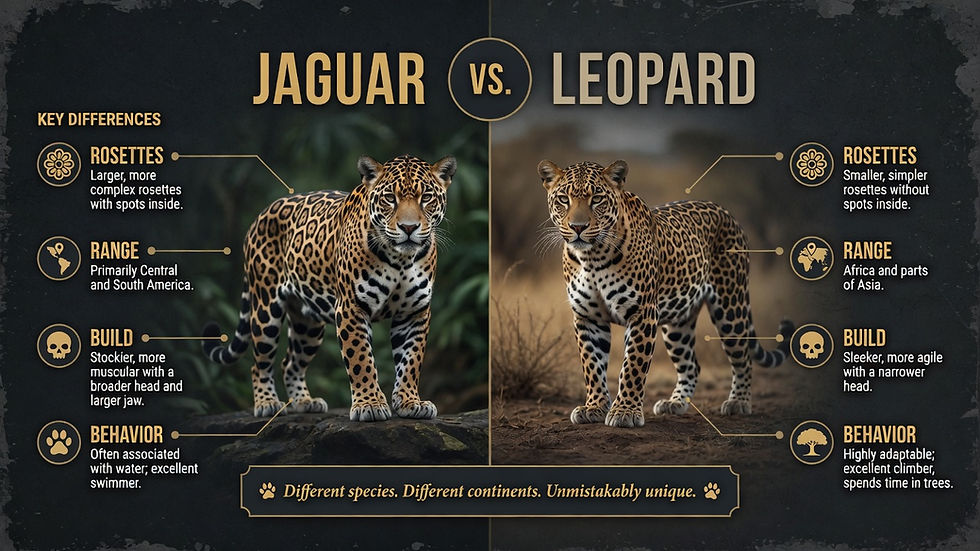
At first glance, jaguars and leopards can look almost identical.
Both have spotted coats.
Both are powerful predators.
Both are members of the big cat family.
Both are capable hunters that play important roles in their ecosystems.
However, they come from different continents and have evolved different strengths.
The easiest way to tell them apart is by looking at their spots.
Jaguars
Jaguars usually have larger rosette patterns with smaller spots inside them.
They are heavier, stockier, and more muscular than leopards. They are native to the Americas, especially Central and South America.
Leopards

Leopards usually have smaller rosettes without spots inside. They are lighter, more agile, and famous for their ability to climb trees and carry prey into branches. They are native to Africa and parts of Asia.
A simple way to remember the difference:
Jaguar = power
Leopard = adaptability
Both are extraordinary. Both are irreplaceable.
Jaguars: The Powerful Guardians of the Americas

Jaguars are the largest cats in the Americas and one of the strongest predators on Earth.
They once roamed from parts of the southern United States through Mexico, Central America, and much of South America.
Today, their range is much smaller.
The strongest remaining populations are found in places such as:
The Amazon rainforest
The Pantanal wetlands
Tropical forests
Areas near rivers and wetlands
Unlike many big cats, jaguars are excellent swimmers. Water is not something they avoid. They often hunt near rivers and wetlands and can take prey both on land and in water. This makes them one of the most unique predators in the world.
What Makes Jaguars So Special?

A jaguar is built for strength. Compared with leopards, jaguars have:
Larger heads
More powerful jaws
Heavier bodies
Stronger muscles
Their bite is among the strongest of all big cats. While many predators kill by suffocation, jaguars are known for delivering powerful bites that can crush bones and pierce heavily protected prey.
Their diet includes:
Deer
Peccaries
Capybaras
Caimans
Fish
Turtles
Birds
Smaller mammals
This incredible versatility helps jaguars survive in some of the most challenging environments on Earth. But their importance goes beyond hunting. Jaguars are apex predators. That means they help maintain balance within their ecosystems. When jaguar populations decline, prey populations can become unstable, which can affect the entire environment. A healthy ecosystem needs predators.
Where Jaguars Live and Why Their Habitat Matters

The biggest threat facing jaguars is habitat loss. A jaguar needs a large territory to survive. When forests are destroyed for agriculture, mining, roads, and development, jaguars lose the space they need.
The consequences are serious:
Fewer hunting areas
Less available prey
Increased human conflict
Reduced breeding opportunities
Isolated populations
The Amazon rainforest is one of the most important ecosystems on Earth. It is home to countless species, including jaguars. When forests disappear, the damage goes far beyond one animal.
It affects:
Wildlife
Indigenous communities
Water systems
Climate regulation
Biodiversity
Saving jaguars means protecting entire ecosystems.
Jaguar Conservation: A Fight That Is Not Over

Jaguars are considered Near Threatened globally, but that classification does not tell the entire story. Many local populations are struggling.
Major threats include:
Habitat Destruction: Forest loss remains the biggest concern.
Human-Wildlife Conflict: As people expand into jaguar territory, encounters increase. Jaguars may be killed after conflicts involving livestock.
Illegal Hunting: Although protected in many regions, jaguars are still targeted for illegal trade and trophies.
Loss of Prey: When animals that jaguars depend on disappear, jaguars suffer as well.
The good news is that conservation works. Protected areas, wildlife corridors, scientific research, and community involvement have helped some jaguar populations survive.
But they need continued protection.
Leopards: The Masters of Adaptation
If the jaguar represents power, the leopard represents survival. Few large predators are as adaptable as the leopard.
Leopards have managed to survive across a huge range of habitats, including:
African savannas
Forests
Mountains
Grasslands
Deserts
Cold regions of Asia
Their ability to adapt has earned them a reputation as one of nature’s greatest survivors.
However, even the most adaptable animals have limits.
Leopards cannot survive without space, prey, and protection.
What Makes Leopards Different?
Leopards are built for stealth and agility. They are exceptional climbers and are famous for dragging their prey into trees.
Why? Because competition is fierce.
In Africa, leopards often share their environment with:
Lions
Hyenas
Wild dogs
A leopard that leaves its meal on the ground risks losing it. By carrying prey into trees, leopards protect their food from larger predators. This requires incredible strength. A leopard can haul prey weighing as much or more than itself into a tree. Their athletic ability is one of the reasons they are so admired.
Leopard Subspecies: The Cats Fighting for Survival
Leopards are not all the same. Different populations developed unique traits based on their environments.
African Leopard
The most widespread leopard population. Found across much of Africa, these cats survive in many different habitats. However, they face threats from habitat loss, human conflict, and declining prey.
Amur Leopard
One of the rarest big cats in the world. Found in parts of Russia and China, this leopard survives in cold forests. These threats include poaching, habitat loss, and prey decline.
Conservation efforts have helped prevent immediate extinction, but the species remains critically endangered.
Arabian Leopard
One of the most endangered leopard populations. Found in the Arabian Peninsula, it faces severe habitat loss and declining numbers.
Indochinese Leopard
Found in Southeast Asia.
This leopard has suffered dramatic declines due to deforestation, illegal widlife trade, and snaring.
Javan Leopard
Found only on the island of Java. Some Javan leopards are black, making them one of the most fascinating leopard populations.
North China Leopard
A lesser-known leopard population threatened by habitat loss and declining prey.
Persian Leopard
The largest leopard subspecies. They're found across parts of Central Asia and the Middle East, but face threats from habitat fragmentation and human conflict.
Sri Lankan Leopard
Found only in Sri Lanka. It is the island’s top predator and an important part of its ecosystem.
The Tragedy of Extinct Leopards
Extinction is the one conservation failure that cannot be reversed. One of the most tragic examples is the Zanzibar leopard. This leopard disappeared because of a combination of persecution, habitat changes, and human actions.
Its extinction is a reminder that myths, fear, and misinformation can have devastating consequences. A species does not need to be hated to disappear. Sometimes it only needs to be ignored.
Black Jaguars and Black Leopards: The Mystery of the Black Panther

Few animals are as captivating as the black panther. However, many people do not realize that "black panther" is not a separate species.
A black panther is usually either:
A black jaguar
A black leopard
The dark coloration is caused by a genetic trait called melanism. The animal is not truly without markings. In the right lighting, the rosettes can still be seen beneath the dark fur.
Black jaguars are most commonly found in areas with dense forests. Their dark coats may provide camouflage in environments with heavy shade and limited sunlight. They are not a different species. They are another example of the incredible genetic diversity found in wild cats.

Black leopards are especially associated with parts of Asia. The Javan leopard has a particularly high number of melanistic individuals. These cats have inspired legends around the world.
But behind the mystery of these black variants of their jaguar and leopard counterparts is a real conservation challenge. They still need protected habitat, healthy prey populations, and freedom from illegal hunting.
Beauty alone cannot save a species. Action can.
Humanity’s Failure as Wildlife Stewards
The decline of jaguars and leopards reflects a much larger problem. Humanity has often failed in its responsibility toward the natural world.
We have achieved incredible things. We have developed technology, medicine, and knowledge beyond what previous generations could imagine. Yet we have also destroyed habitats, polluted ecosystems, and allowed species to disappear.
The problem is not progress itself.
The problem is believing progress requires destruction.
Greenwashing and Empty Promises


Today, many companies, organizations, and politicians use environmental language. Some genuinely work toward conservation. Others use sustainability messaging because it improves public image and wins political votes. This is where accountability matters.
Real conservation is not:
A catchy slogan
A logo with a leaf on it
A publicity campaign
Real conservation means:
Protecting habitats
Reducing environmental damage
Supporting biodiversity
Creating measurable results
Wildlife does not survive because a company claims to care. It survives because people make decisions that actually protect it.
Why Conservation Matters to Everyone
Protecting jaguars and leopards is not only about saving beautiful animals. It's about protecting the balance of life.
Healthy ecosystems provide:
Clean water
Stable climates
Food systems
Biodiversity
Natural resources
When we lose species, we weaken the systems that support all life. Conservation is not about choosing animals over people. It is about understanding that people are part of nature, not separate from it.
Why Apathy Is Dangerous
One of the greatest threats facing wildlife is indifference.
People often assume:
"Someone else will fix it."
"One person cannot help."
"It is too late anyway."
But history shows that change happens when people refuse to accept destruction as inevitable.
The recovery of endangered species proves that action works. Apathy allows problems to continue. Compassion creates change.
Where Cattytude Stands
Cattytude believes education is one of the most important parts of conservation. People protect what they understand. They care about what they learn to appreciate. That is why Cattytude focuses on sharing stories about cats, from beloved companion animals to endangered wild species.
The mission is simple:
Celebrate cats
Educate people
Support conservation
Encourage responsible choices
Cattytude also believes transparency matters. Supporting wildlife should involve genuine concern for animals and ecosystems, not simply using conservation as a marketing tool. We personally donate 10% of each sale to support organizations and sanctuaries who truly are committed to making a difference. We can't donate to all of them (yet), but we do what we can.
How You Can Help Jaguars and Leopards
Everyone can contribute.
You can:
Learn about endangered species
Share conservation information
Support reputable organizations
Make thoughtful purchasing decisions
Avoid products connected to wildlife harm
Teach children respect for animals
Speak up for habitat protection
You do not have to be wealthy or famous to make a difference. Conservation begins with caring.
Frequently Asked Questions
Are jaguars and leopards the same animal?
No. They are different species from different continents. Jaguars vs. leopards also have different coats. Jaguars have spots inside their rosettes while leopards don't.
Which is stronger, a jaguar or a leopard?
Jaguars are generally stronger and heavier, with one of the most powerful bites among big cats.
Are black panthers a separate species?
No. They are usually melanistic jaguars or leopards.
Are jaguars endangered?
Jaguars are classified as Near Threatened globally, but many populations are declining.
Which leopard is the rarest?
The Amur leopard is one of the rarest big cats on Earth.
Why are predators important?
Predators help maintain healthy ecosystems by balancing prey populations.
Can extinct animals be brought back?
No. Extinction is permanent. Protecting species before they disappear is critical.
References and Further Reading
Panthera: Global wild cat conservation organization
International Union for Conservation of Nature (IUCN) Red List
World Wildlife Fund: Big Cats Conservation
Final Thought
The future of jaguars and leopards is in our hands. So, what are we going to do about it? Will we be remembered as the generation that watched these magnificent cats disappear? Or will we be remembered as the generation that finally understood our responsibility and chose to protect them?
The choice is still ours, for now.


Comments