
Jaguar Conservation: Black Jaguars, Subspecies, Threats & How to Help

Updated: Jul 31
Jaguars are the largest cats in the Americas. When one steps out of the shadows, everything stops. That massive head, those powerful shoulders, the quiet confidence of an animal that belongs exactly where God placed it. They once ranged from the southwestern United States all the way through Central America and deep into South America. Today nearly half of that range is gone. The IUCN lists them as Near Threatened. Outside the Amazon core, many populations are in serious trouble.
These are not just beautiful animals. They are living proof of the Creator’s design. When jaguars vanish from a forest or wetland, the balance shifts. Prey numbers change. The land itself feels the loss.
God gave mankind a clear responsibility.
In Genesis 1:26-28 (NKJV) we read: Then God said, “Let Us make man in Our image, according to Our likeness; let them have dominion over the fish of the sea, over the birds of the air, and over the cattle, over all the earth and over every creeping thing that creeps on the earth.” So God created man in His own image; in the image of God He created him; male and female He created them. Then God blessed them, and God said to them, “Be fruitful and multiply; fill the earth and subdue it; have dominion over the fish of the sea, over the birds of the air, and over every living thing that moves on the earth.”
Genesis 2:15 (NKJV) says: Then the Lord God took the man and put him in the garden of Eden to tend and keep it.
And Proverbs 12:10 (NKJV) declares: A righteous man regards the life of his animal, But the tender mercies of the wicked are cruel.
Caring for the animals God made is not optional. It is part of the assignment He gave us.
Who Is Driving Jaguars Toward Extinction

Poachers still kill jaguars for skins, teeth, and claws. But the bigger killer is habitat loss. Cattle ranching, industrial soy, mining, and new roads keep wiping out the forests and wetlands these cats need to survive.
This destruction does not happen by accident. Large corporations push it while publicly claiming they care about the planet. Many of the same companies that clear jaguar habitat also advertise “net-zero” goals, sustainability pledges, and green branding. They sell the image of environmental responsibility while their supply chains drive deforestation. That is greenwashing, and it is widespread.
AI data centers are making the problem worse. These facilities consume enormous amounts of electricity and water. Meeting that demand often means new power plants, expanded transmission lines, and greater pressure on land and water resources. Many of the companies building and running these data centers promote themselves as climate leaders while their energy and resource needs keep growing at a rapid pace. The green claims and the actual environmental footprint do not match.
Politicians do the same. They give speeches about protecting biodiversity and fighting climate change. Then they approve mining concessions, energy projects, and infrastructure that push deeper into critical habitat, or they look the other way when powerful industries expand. The public statements and the actual policies do not match.
Mainstream media often fails to call this out clearly. Coverage tends to focus on individual poachers or isolated incidents while giving far less attention to the corporate, technological, and political systems that make large-scale habitat loss possible. The result is that the public hears about “conservation efforts” without seeing the full picture of who benefits from the destruction.
This gap between words and actions is a major reason jaguar populations (and other animals) continue to decline. When habitat keeps disappearing under the cover of green promises, net-zero pledges, and high-tech progress, the cats lose. Empty claims do not protect a single forest corridor or save a single cub.
Jaguar Subspecies

People have long noticed real differences between jaguars from different regions. The biggest differences are in size and coat color. Here are the main groups, listed alphabetically, with those differences noted under each.
Arizona Jaguar
Historically found in the southwestern United States and northern Mexico. These northern jaguars are generally smaller than the large Pantanal animals of South America.
Modern records of males that have crossed into Arizona (such as the well-known jaguar called El Jefe) put them in the range of roughly 120 to 150 pounds. They are more comparable in size to Central American jaguars than to the biggest South American ones. Sightings north of the Mexican border remain extremely rare.
Central American Jaguar
Ranges through Central America. These jaguars are typically smaller than the big Pantanal animals and often darker in coat color because they live in denser forest habitats. Habitat fragmentation and human conflict have reduced their numbers in many areas.
Goldman’s Jaguar
Associated with the Yucatán Peninsula and nearby regions. Similar in size to other Central American jaguars, generally smaller and darker than open-country populations. Continues to face pressure from habitat loss.
Pantanal Jaguar
Lives in the Pantanal wetlands of South America. These are the largest jaguars. Adult males regularly reach 220 to 300 pounds, and some exceptional animals have exceeded 330 pounds. Their coats are usually lighter and more golden because they live in more open wetland habitat. This remains one of the stronger populations, though still under threat.
Paraguayan Jaguar
Found in parts of Paraguay, Brazil, and northern Argentina. These jaguars fall between the large Pantanal animals and the smaller forest forms in size. Habitat is fragmented, and conflict with people is common.
Peruvian Jaguar
Lives in Peru and surrounding regions. These are typically smaller and darker forest jaguars. Ongoing forest loss puts steady pressure on them.
Veracruz Jaguar
Associated with northeastern Mexico. Generally similar in size to other northern and central Mexican populations, larger than deep-forest Central American jaguars. Numbers have declined as land has been converted.
West Mexican Jaguar
Found along western Mexico. These jaguars tend to be medium to large in size compared to southern forest populations. Habitat loss and conflict have reduced their numbers.
Broader South American Jaguar
The most widespread form across much of South America, including large parts of Brazil and the Amazon. Size varies by habitat. Forest animals are usually smaller and darker, while those in more open areas grow larger and lighter in color. Even these populations face continued deforestation.
Most scientists now treat all living jaguars as one species with natural regional variation in size and coat color. The names above still help us talk about the different populations and the places they are trying to survive.
What Makes Black Jaguars Special
A black jaguar is not a different animal. It is a jaguar born with a genetic trait called melanism. The coat floods with dark pigment until it looks almost solid black. In the right light, the classic rosettes still show through like ghosts.
These black cats appear more often in the densest, wettest forests. The dark fur helps them melt into deep shadow. They hunt the same way, swim the same rivers, and carry the same power as the spotted ones. What makes them special is that rare, breathtaking appearance and the extra camouflage it gives them in the thickest cover. Seeing one is something a person never forgets.
Stories That Show What Is Possible
In Mexico, national surveys show the jaguar population has grown by more than 30 percent since 2010, reaching over 5,300 animals. Protected areas, camera-trap monitoring, and stronger anti-poaching work made the difference. In the Pantanal, researchers and local communities have watched mother jaguars raise cubs in places where coexistence programs reduced conflict. In the borderlands of Arizona and New Mexico, volunteers still check camera traps hoping for another rare northern sighting.
These stories prove that when people choose to protect habitat and work with local communities, jaguars can hold on and even recover.
Panthera’s Jaguar Corridor Initiative works across the entire range to keep populations connected so genes and animals can still move. Carson Springs Wildlife Foundation and the National Tiger Sanctuary provide care and education for wild cats that need a second chance. Cattytude sends 10 percent of every sale to these three organizations so everyday purchases become real support on the ground.
How You Can Help Protect Jaguars
Give to organizations doing verified field work. Never buy jaguar skins, teeth, claws, or anything made from them.
Choose made-to-order products. They waste far less than mass production.
Support tourism that leaves forests standing and does not feed the illegal trade.
Speak up for stronger wildlife laws and land planning that keeps corridors open.
Share accurate information and push back against myths that create fear or demand for body parts.
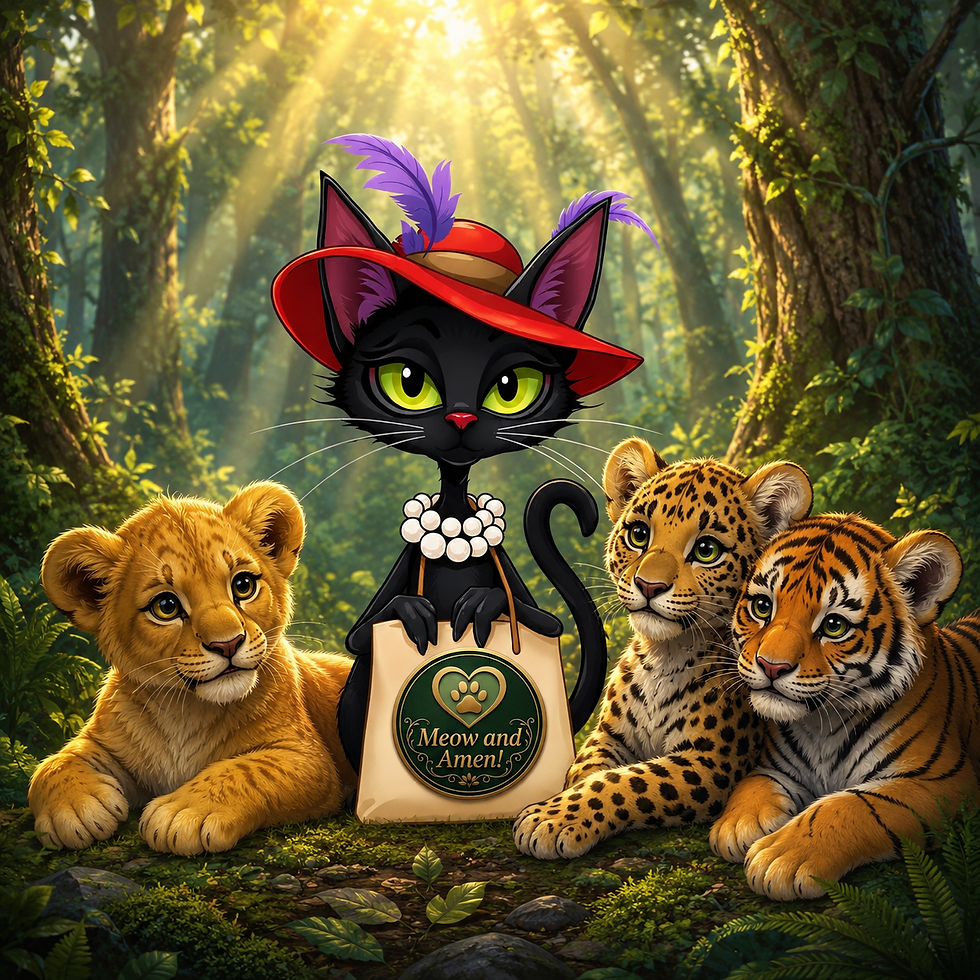
Supporting brands that direct a portion of sales to proven conservation groups is another practical step. Cattytude works with a made-to-order model, creating cat-themed apparel and gifts designed to honor each cat species. Every item is produced only when ordered, which avoids the waste of traditional mass production. We focus on more ethical and environmentally responsible options whenever possible.
One of our beloved mascots is BB, our artistic creation of a black jaguar. He represents the rare melanistic cats and reminds people why they are worth protecting. Ten percent of every Cattytude purchase goes to Carson Springs Wildlife Foundation, Panthera, and the National Tiger Sanctuary.
Frequently Asked Questions
Are black jaguars a different species?
No. They are the same species. The black coat comes from melanism.
How many jaguars are left?
Exact numbers are hard to pin down. The species is Near Threatened. The Amazon holds the largest numbers. Many other populations are small and declining.
What is the biggest threat?
Habitat loss from ranching, agriculture, mining, and roads, followed by poaching and conflict with people.
Can someone keep a jaguar as a pet?
No. They are wild animals protected by law and completely unsuitable as pets.
What is the most effective thing one person can do?
Support proven conservation groups with donations and refuse products or industries that destroy habitat or fuel the illegal wildlife trade.
Key Resources
IUCN Red List – Jaguar: https://www.iucnredlist.org/
Panthera Jaguar Program: https://panthera.org/cat/jaguar
Carson Springs Wildlife Foundation: https://www.carsonspringswildlife.org/
National Tiger Sanctuary: https://nationaltigersanctuary.org/
World Wildlife Fund – Jaguar: https://www.worldwildlife.org/species/jaguar
Wildlife Conservation Society: https://www.wcs.org/
IUCN Cat Specialist Group: https://www.catsg.org/
The Wildcat Sanctuary: https://www.wildcatsanctuary.org/
Jaguars still have a future. Habitat can be protected. Conflict can be reduced. Poaching can be stopped. The organizations already doing the hard work need people who care enough to stand with them.
These cats were made by God. Looking after them is part of the responsibility He gave us.
Cattytude: Ethics, Faith, and the Wild

Every purchase is a mission. 10% of every sale is donated to Carson Springs, Panthera, The Wildcat Sanctuary, and the National Tiger Sanctuary to protect our planet’s magnificent wildlife. By choosing made-to-order fashion, we honor God’s creation and reject the waste of mass production.
Wear your values. Shop with purpose. #MeowAndAmen


Comments