
Caracal Cats: Facts, Habitat, Hunting Power, and the Urgent Fight to Protect Them

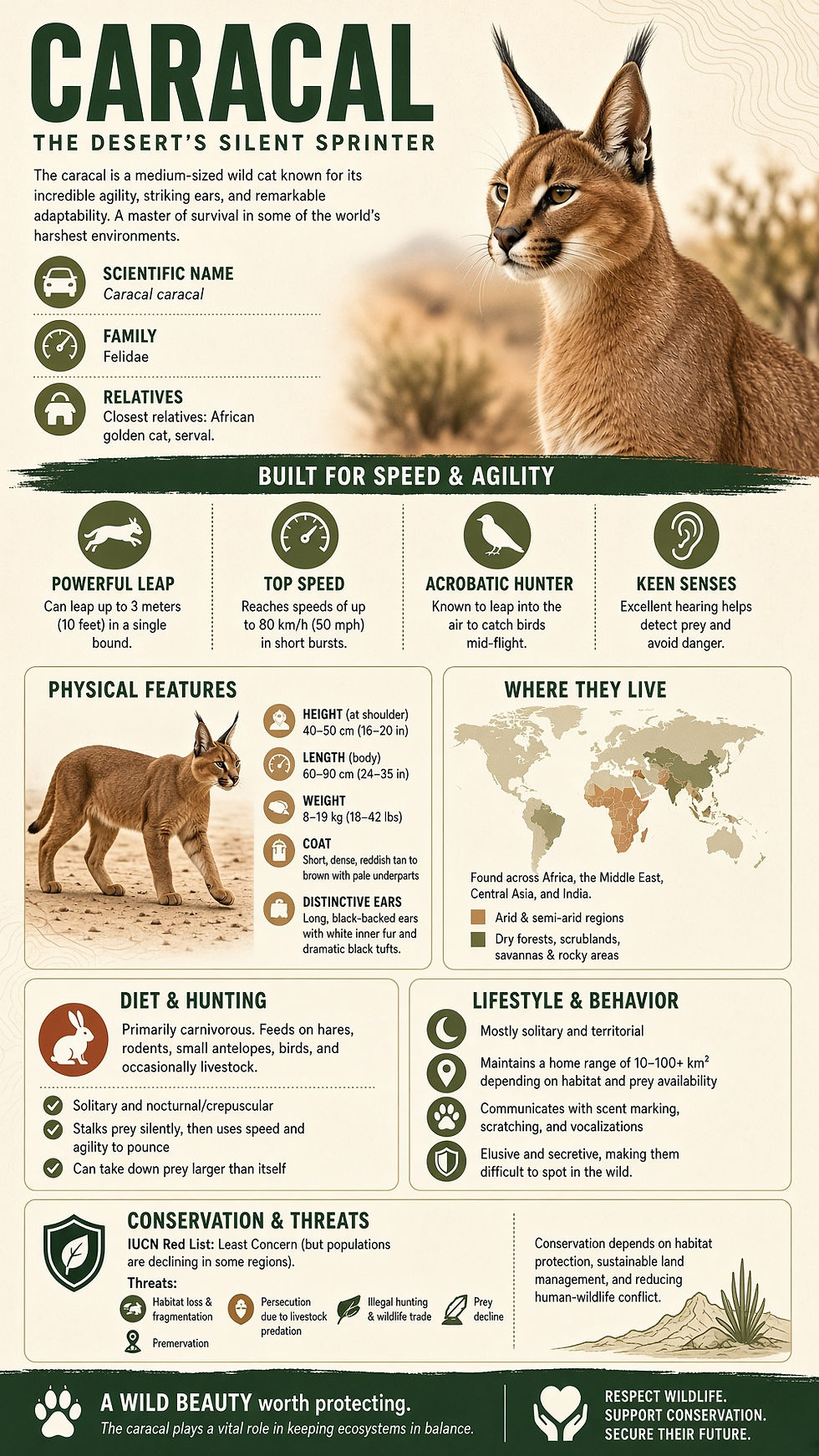
The caracal (Caracal caracal), often called the desert lynx or African lynx, is one of the most striking medium-sized wild cats on Earth. With its long black ear tufts, powerful hind legs, and remarkable leaping ability, this solitary predator thrives across vast stretches of Africa, the Middle East, Central Asia, and parts of India. While the species is listed as Least Concern globally by the IUCN Red List, regional populations in North Africa and Asia face serious declines from habitat loss, persecution, and illegal trade.
This article delivers the key facts search engines and readers look for while confronting the hard truths about threats to caracals and all wild cats. It also calls out the systems and attitudes that keep those threats alive.
Caracal Physical Characteristics
Adult caracals measure roughly 61 to 106 cm in body length, with a short tail of 19 to 34 cm. Males typically weigh 8 to 20 kg (up to about 44 pounds), while females are lighter at 6 to 16 kg. Their coats range from reddish-brown to tawny or sandy, providing excellent camouflage in dry landscapes. The signature black ear tufts may aid hearing or visual signaling. Strong hind legs allow them to leap more than 3 meters (nearly 10 feet) into the air to swat birds mid-flight. Lifespan averages 10 to 12 years in the wild and up to 16 to 19 years in captivity.
Habitat and Geographic Range
Caracals prefer open or semi-open dry habitats: savannas, scrublands, steppes, dry woodlands, rocky hills, and semi-deserts. They avoid dense rainforests and true sandy deserts. Their range spans much of sub-Saharan Africa (where populations are generally more stable), North Africa (where they are rare or threatened), the Arabian Peninsula, the Middle East, Central Asia, and into northwestern India and Pakistan. They occur from sea level up to elevations of 3,000 meters or more in some mountain areas.
Diet, Hunting, and Behavior
Caracals are strict carnivores and opportunistic hunters. Their diet centers on small to medium mammals (rodents, hares, hyraxes, and young antelope), birds, and occasionally reptiles or larger prey when opportunity arises. They are famous for leaping to catch birds in flight. Primarily solitary and often nocturnal or crepuscular, they become more active by day in cooler conditions or protected areas. They communicate with growls, hisses, mews, and purrs. Females give birth to litters of 1 to 6 kittens after a gestation of roughly 68 to 81 days. Kittens stay with the mother for about a year before becoming independent.
Conservation Status and Real Threats

Globally Least Concern, caracals still face declining trends in many regions. Asian populations receive higher CITES protection (Appendix I) than most African ones (Appendix II). Major threats include habitat fragmentation from agriculture and development, retaliatory killing by livestock farmers, vehicle collisions, prey depletion, and illegal trade for skins, traditional use, and the exotic pet market.
Poachers kill these cats for profit. The fashion trade turns wild animal skins and parts into “status” products. Certain pharmaceutical and traditional medicine markets still drive demand for animal body parts. Corporations, politicians, and legacy media often engage in greenwashing: glossy sustainability claims, photo-ops, and empty pledges that distract from continued habitat destruction and weak enforcement. The result is the same: fewer wild places and more pressure on species like the caracal.
People who wear or proudly display real animal skins, trophies, or body parts do not look elegant or powerful. They appear hideous. That choice reveals a lifestyle that caters to purely selfish needs. They willfully live all seven deadly sins as a lifestyle choice. Pride elevates personal image above the value of living creatures. Greed treats God’s animals as commodities. Lust for novelty and status fuels the trade.
Envy fuels the competition to display the most uncommon "prize." Gluttony takes more than necessary as ecosystems crumble. Wrath strikes against predators that threaten livestock or personal pride. Sloth resists altering habits or advocating for improved systems. These people bear even more responsibility as the poachers who fire the gun or lay the trap, as it is they who fuel the trade. Taking or endorsing the taking of God's majestic creatures for gain is not fashion. It is sin in plain sight.
Human Stewardship and the Cost of Apathy
Scripture is clear. Humanity was appointed as stewards of God’s creation, which includes the animals and the planet that sustains us all. We have failed on every account. Habitat is shredded. Species decline. Pollution and climate disruption accelerate.
Choosing to do nothing, to stay comfortable while the destruction continues, makes us apathetic. The Bible states the outcome plainly for the lukewarm church and everyone in it: “So then because thou art lukewarm, and neither cold nor hot, I will spue thee out of my mouth” (Revelation 3:16). Apathy is not neutral. It is rejection of the stewardship role we were given.
Cattytude’s Position on Wildlife Conservation

Cattytude stands firmly for wildlife conservation and the protection of wild cats. We prefer to use feline-themed made-to-order prints to show our appreciation for all cats. We stick with sources that really do care about the environment and wildlife preservation.
We also donate 10% of each sale to these organizations:
These groups focus on rescue, habitat protection, anti-poaching work, research, and education instead of empty corporate slogans. Supporting genuine conservation is one practical way individuals can reject apathy and act as better stewards.
Frequently Asked Questions
Are caracals endangered?
Globally, they are Least Concern, but populations in North Africa and parts of Asia are rare, threatened, or critically low in some countries. Trends are decreasing in many areas.
Can caracals be kept as pets?
No. They are wild animals with complex needs, strong hunting instincts, and potential for aggression. Demand for exotic pets fuels capture and trafficking that harms wild populations.
How high can a caracal jump?
They can leap more than 3 meters (about 10 feet) vertically to catch birds in flight.
What do caracals eat?
Mainly small to medium mammals and birds. They are opportunistic and will take larger prey or livestock when available.
Why are caracals persecuted?
They sometimes kill small livestock, leading farmers to trap, shoot, or poison them. Habitat loss and the pet and skin trades add further pressure.
How can ordinary people help?
Support verified conservation organizations, reject products made from wild animals, reduce habitat-destroying consumption, and speak against greenwashing and weak enforcement. Action beats lukewarm indifference.
References for Additional Reading
IUCN Cat Specialist Group: https://www.catsg.org/living-species-caracal
San Diego Zoo Animals & Plants: https://animals.sandiegozoo.org/animals/caracal
Urban Caracal Project: http://www.urbancaracal.org/caracal-basics
Animal Diversity Web: https://animaldiversity.org/accounts/Caracal_caracal
Endangered Wildlife Trust: https://ewt.org/project/caracal/
Caracal Conservation and Research Project: https://www.ccarp.org/


Comments